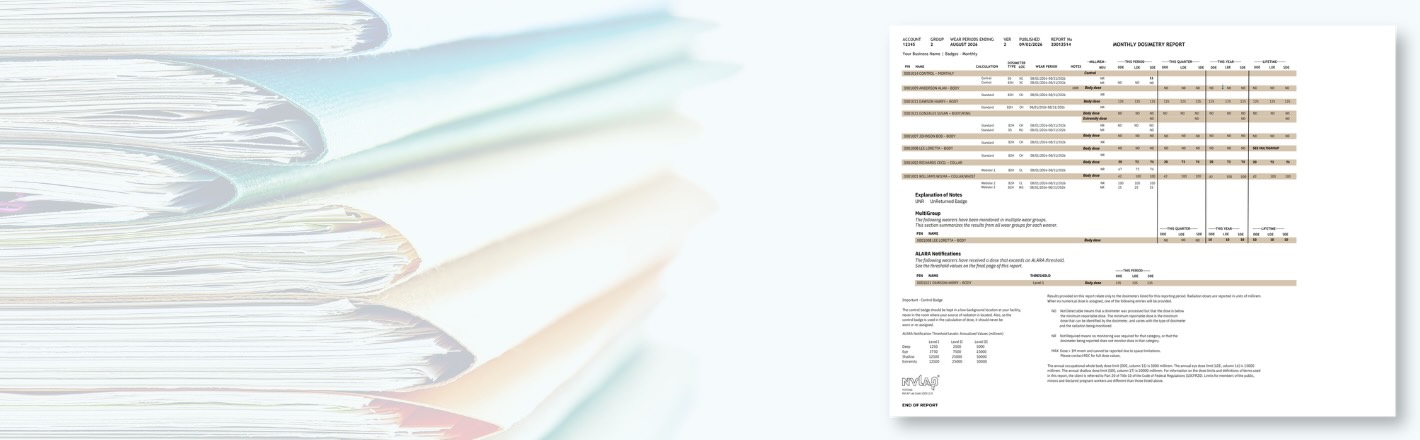
A radiation dosimetry report provides a record of the occupational radiation dose measured for monitored workers during a specific wear period. But if you're new to managing a dosimetry program, abbreviations such as DDE, LDE, and SDE can make a relatively straightforward report look much more complicated.
Understanding these measurements and what they do and do not tell you is important for reviewing employee dose, identifying results that may warrant further evaluation, and maintaining an effective radiation protection program.
Here is what the most common values on an occupational dosimetry report mean.
The definitions and dose limits below are drawn from US Nuclear Regulatory Commission (NRC) regulations. State radiation control programs, which regulate most X-ray facilities and, in Agreement States, radioactive materials, generally use the same dose quantities and limits. US Department of Energy (DOE) facilities follow 10 CFR 835, which uses different dose terminology. Always check the requirements of the regulator that applies to your facility.
What Does a Radiation Dosimetry Report Show?
A personnel dosimeter measures exposure to ionizing radiation and is processed or read to determine applicable dose quantities. Depending on the dosimeter, monitoring application, and reporting system, a dose report may include results for the current wear period along with cumulative values such as quarter-to-date or year-to-date dose.
Three common external dose quantities are:
- DDE – Deep-Dose Equivalent
- LDE – Lens Dose Equivalent
- SDE – Shallow-Dose Equivalent
These values represent dose equivalent at different tissue depths and should not be treated as interchangeable measurements.
What Is Deep-Dose Equivalent (DDE)?
Deep-Dose Equivalent (DDE) applies to external whole body exposure and is defined as the dose equivalent at a tissue depth of 1 centimeter (1,000 mg/cm²). Under NRC regulations, the annual occupational dose limit for an adult is 5 rem (50 mSv) for the total effective dose equivalent (TEDE), which includes the deep-dose equivalent from external exposure and the committed effective dose equivalent from internal exposure.
DDE is intended to represent penetrating external radiation exposure to the whole body and is therefore one of the key values used in occupational radiation monitoring.
"Whole body" includes the upper left arm, upper right arm, upper left leg, upper right leg, torso, neck, and head. Dosimeter placement should be at the highest DDE among the whole body locations.
For most monitored workers, the DDE from the whole body dosimeter is used as the external component of TEDE. The exception is when a regulator-approved method is used to calculate effective dose equivalent instead, such as the methods used for workers wearing lead aprons (see below).
That distinction matters: DDE and TEDE are not necessarily the same quantity. Where internal exposure is present, additional dose quantities must be considered.
What Is Lens Dose Equivalent (LDE)?
Lens Dose Equivalent (LDE) applies to external exposure of the lens of the eye and is defined as the dose equivalent at a tissue depth of 0.3 centimeter (300 mg/cm²). Under NRC regulations, the annual occupational dose limit for an adult is 15 rem (150 mSv).
LDE can be particularly relevant for employees who work near sources of scatter radiation or in procedures where the head and eyes may receive occupational exposure.
Because LDE measures a different dose quantity than DDE, an LDE result should be evaluated against the requirements and administrative controls applicable to lens exposure rather than simply compared with a whole body dose value.
What Is Shallow-Dose Equivalent (SDE)?
Shallow-Dose Equivalent (SDE) applies to external exposure of the skin of the whole body or the skin of an extremity and is defined as the dose equivalent at a tissue depth of 0.007 centimeter (7 mg/cm²). Under NRC regulations, the annual occupational dose limit for an adult is 50 rem (500 mSv) to the skin of the whole body or to any extremity.
SDE is especially important when monitoring work in which the hands, fingers, or skin of the whole body may be positioned closer to a radiation source.
For radiation protection purposes, the extremities include the arms below the elbows, including the forearms, wrists, hands, and fingers, and the legs below the knees, including the lower legs, ankles, feet, and toes. This applies to both the left and right extremities.
For example, workers handling radioactive materials may require an extremity dosimeter, such as a ring dosimeter, in addition to a whole body dosimeter when extremity monitoring is required or appropriate.
If multiple extremity monitors are used, dose reports document the maximum extremity dose over the entire year. For example, a left finger ring and a right finger ring could compete for the maximum throughout the year, but the higher of the two at the end of the year is reported.
DDE vs. LDE vs. SDE: What's the Difference?
The easiest way to understand the three measurements is to remember that they represent dose equivalent at different tissue depths:
- DDE: 1 cm depth – penetrating external radiation exposure to the whole body
- LDE: 0.3 cm depth – external radiation exposure to the lens of the eye
- SDE: 0.007 cm depth – external radiation exposure to the skin of the whole body or an extremity
The numbers on a dose report therefore should not be compared with one another as though the highest number automatically represents the most significant result.
Each dose quantity has a specific meaning and should be evaluated in the context of the worker's monitoring configuration, applicable regulatory requirements and the facility's radiation protection program.
What Does ALARA Mean on a Dosimetry Report?
ALARA means As Low As Reasonably Achievable.
ALARA is a fundamental radiation protection principle. Under NRC regulations, licensees are required, to the extent practicable, to use procedures and engineering controls based on sound radiation protection principles to achieve occupational doses that are ALARA.
Importantly, ALARA is not an additional federal occupational dose limit.
A facility may establish administrative or investigation levels below applicable regulatory limits to help identify dose results that warrant review. These levels can be used as part of a radiation protection program to identify trends, investigate unexpected exposure, and determine whether changes to work practices or controls should be considered.
Reaching an organization's ALARA investigation level therefore does not by itself mean that a worker has exceeded a regulatory dose limit.
It means the result should be evaluated according to the organization's radiation protection program and applicable requirements.
What Should You Look for When Reviewing a Dose Report?
A good dose-report review involves more than checking whether a result is below a regulatory limit.
Radiation Safety Officers and program administrators may consider the factors below.
Unexpected Changes
Is a worker's dose substantially different from previous wear periods?
Dose Trends
Is exposure gradually increasing over several reporting periods?
Job and Procedure Changes
Has the employee begun performing different procedures, working longer hours around radiation, or working in a different location?
Dosimeter Placement
Was the dosimeter worn in the correct location for the monitoring protocol?
Unusual Events
Could the badge have been left near a radiation source, taken home, exposed during transport, or otherwise subjected to radiation that was not occupational exposure to the assigned wearer?
Control Dosimeter Results
Most dosimeter shipments include a control dosimeter that travels with the badges but is stored away from radiation sources during the wear period. Its reading represents background and transit exposure, which is subtracted from wearer results so that reported doses reflect occupational exposure. If the control was stored near a radiation source or worn by mistake, wearer results may be understated, so keep the control in a designated low-background location and never use it as a spare.
Administrative or ALARA Levels
Does the result meet a facility-established threshold requiring review or investigation?
An unusual result does not automatically indicate that an employee received an unusual occupational dose. It is a signal to review the circumstances and determine whether additional evaluation is necessary.
What Does "ND" or a Very Low Result Mean?
"ND" stands for "Not Detectable" and is an established designation used in occupational radiation dose reporting. The US Nuclear Regulatory Commission (NRC) recognizes ND on Form 5, Occupational Dose Record for a Monitoring Period, to indicate that monitoring was performed but the dose was not measurable.
All dosimetry systems have detection limits and minimum reporting thresholds. A result reported as non-detectable or below the reporting threshold does not necessarily mean that no radiation exposure occurred. Rather, it indicates that a reportable dose was not determined above the applicable detection or reporting threshold for that dosimeter and monitoring period.
Reporting thresholds can differ by dosimeter type and dose quantity. For RDC whole body passive dosimeters, the minimum reportable DDE is 10 mrem. Understanding the reporting threshold of your dosimetry system is important when interpreting low-dose results and comparing results between technologies or providers.
When occupational exposure falls below a dosimeter's lower limit of detection (LLD), some exposure may not be reflected as a numerical dose in the worker's report. This is sometimes referred to as missed dose.
Monitoring frequency can influence the potential for missed dose, particularly for workers who routinely receive very low levels of radiation exposure. Longer wear periods may allow more exposure to accumulate above the detection threshold before the dosimeter is processed. For example, quarterly monitoring may capture low-level cumulative exposure that would otherwise fall below the detection threshold during individual monthly wear periods.
However, longer wear periods are not appropriate for every application. Monitoring frequency should account for expected exposure levels, dosimeter performance, regulatory requirements, and the need to identify unusual exposure promptly.
What About Workers Who Wear Lead Aprons?
Dose interpretation can become more complex when workers wear protective lead aprons, particularly in interventional radiology, cardiac catheterization, fluoroscopy, and similar environments.
Depending on the monitoring program, a worker may wear one dosimeter at the collar outside the apron or two dosimeters – one outside the apron at the collar and another beneath the apron at the torso or waist.
Because lead aprons shield portions of the body while leaving other areas exposed, the dose recorded by an individual dosimeter may not accurately represent the worker's effective dose equivalent (EDE).
For workers wearing two dosimeters (one outside the apron at the collar and another beneath the apron at the torso or waist), an approved calculation method may be used to estimate EDE by accounting for differences in exposure across the body.
RDC supports the Webster method for dual-dosimeter configurations. This method uses readings from both dosimeters to calculate an estimated effective dose equivalent, providing a more representative assessment of occupational exposure when protective aprons are worn.
Calculation methods and regulatory acceptance vary by jurisdiction. Organizations should document dosimeter placement, the calculation methodology used, and applicable regulatory requirements.
A Dose Report Is More Than a Compliance Record
A well-managed dosimetry program doesn't simply collect reports.
Occupational dose reports also serve as important documentation of a facility's radiation protection program. They provide a record of monitored employee exposure that can help demonstrate compliance with applicable regulatory requirements. These records may also serve as evidence in regulatory inspections, workplace exposure investigations, or legal proceedings involving occupational radiation exposure.
Over time, occupational dose data can help radiation safety teams identify patterns, investigate unusual results, evaluate work practices, and better understand how exposure differs across employees, departments, and facilities.
That's where looking beyond an individual reporting period becomes valuable.
RDC customers can access dose reports through MyRadCare™, while organizations managing larger or more complex programs can use MyRadCare+ to visualize dose trends, analyze results across departments and facilities, and identify information that may warrant closer review.
The goal isn't simply to know what DDE, LDE, and SDE stand for. It's to understand what the data is telling you – and use that information to support a strong, proactive radiation safety program.
Contact RDC to speak with a dosimetry expert →
Explore flexible radiation badge monitoring options →
This article provides general information and is not legal or regulatory advice. Dose quantities, limits and calculation methods vary by regulatory agency, state, and license conditions. Consult your Radiation Safety Officer, a qualified health physicist, or your regulatory agency for guidance specific to your facility.
Ready to Simplify Your
Radiation Safety Program?
Join 41,000+ organizations who trust Radiation Detection Company for accurate, timely, hassle-free radiation monitoring service.









 Previous
