NetDose™ and Radiant solve different radiation monitoring needs. NetDose™ provides NVLAP-accredited dose-of-record monitoring (Lab Code 600295-0) with hourly exposure data, while Radiant provides immediate dose rate and cumulative dose feedback during procedures. Here’s how each can work independently or together across different exposure environments.
Digital and real-time technologies can provide radiation workers and safety teams with much more timely dose and exposure information. With more options than ever before, many organizations are asking whether they need digital dosimetry, real-time dosimetry, or both – and how to know if NetDose™ or Radiant are right for their team.
Of course, the answer depends on the exposure environment and what you need to do with the information.
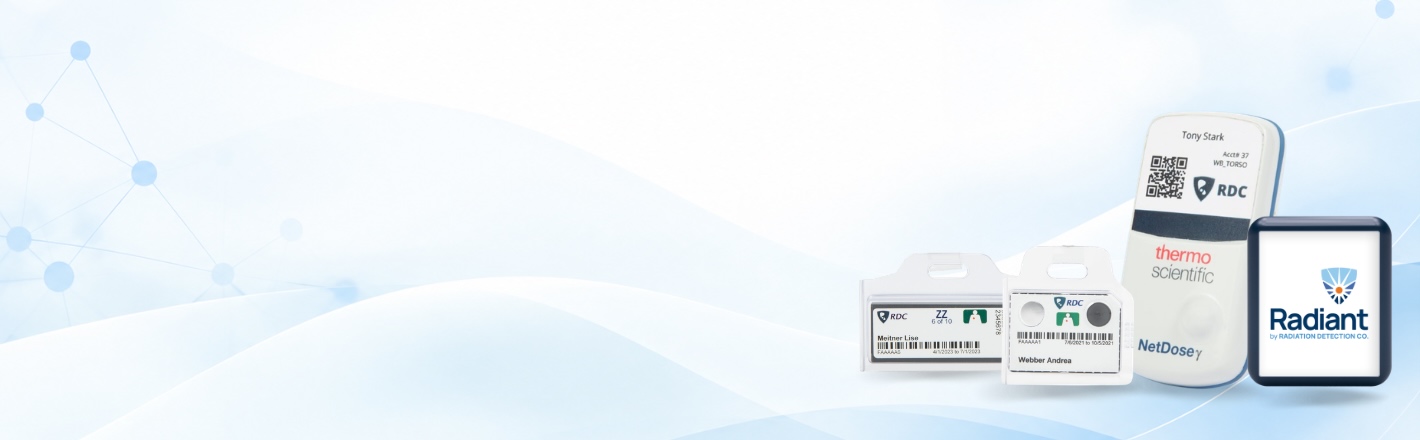
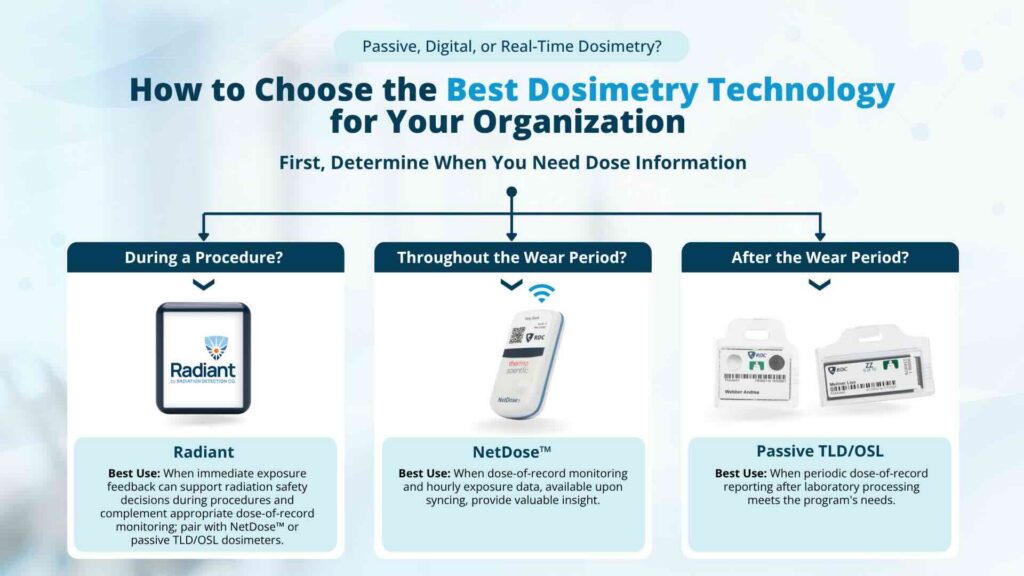
NetDose™ digital dosimeter is designed for ongoing occupational monitoring. It provides NVLAP-accredited dose reports (Lab Code 600295-0) and automatically records exposure data every hour, storing the results in its internal memory. Upon syncing, this detailed data is transferred and can be reviewed online or through the mobile app.
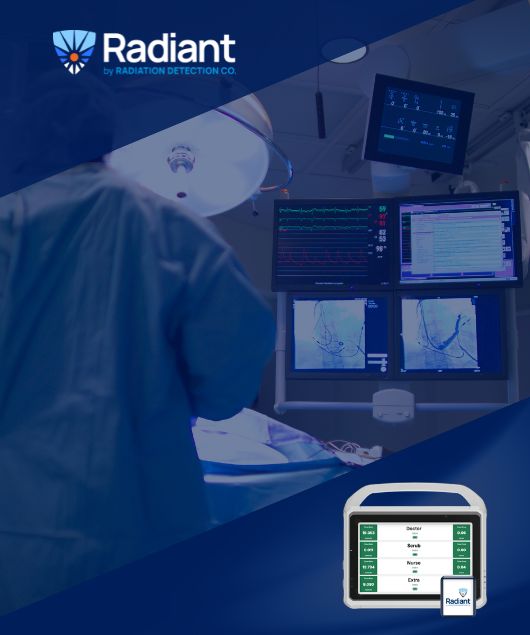
Radiant real-time dosimetry is designed for immediate exposure awareness. The system continuously transmits exposure data to a centralized database, capturing five readings per second. Both cumulative dose and dose rate are displayed immediately, allowing clinicians to see changes in exposure during a procedure and adjust positioning, shielding, distance, or other radiation safety practices as needed.
For some workers, traditional passive dosimetry may be sufficient. For others, NetDose™ alone may provide the right level of information. And in higher-exposure procedural environments, NetDose™ and Radiant can work together to provide two different views of occupational exposure.
This guide will help you determine what information your team needs and when that information becomes useful for optimal radiation safety.
Key Takeaways
NetDose™ and Radiant serve different purposes: NetDose™ provides dose-of-record monitoring and hourly exposure data, and Radiant provides immediate exposure feedback during procedures.
NetDose™ can be used independently when organizations need compliant personnel monitoring with greater exposure visibility than traditional passive dosimetry provides.
Radiant complements dose-of-record monitoring in higher-exposure environments where immediate feedback can help workers understand changing exposure conditions.
Higher-exposure workers may benefit from both technologies: Radiant shows what is happening during a procedure, and NetDose™ can show when occupational dose accumulated over time.
More monitoring technology isn't automatically better. The appropriate combination depends on the worker's exposure environment and whether more immediate information can support radiation safety decisions.
What Is the Difference Between NetDose and Radiant?
The biggest difference between NetDose™ and Radiant is when exposure information becomes available and how that information is intended to be used.
NetDose™ provides a longitudinal record of occupational exposure, with data available down to hourly intervals. It is also NVLAP-accredited for personnel dosimetry program (Lab Code 600295-0), meaning it can provide the worker's dose of record under 10 CFR 20.1501(d).
Radiant provides immediate exposure information during procedures, with updates as fast as every 0.2 seconds. Rather than establishing the worker's dose of record, its purpose is to make changing exposure conditions visible while the work is happening. The database and display can show cumulative case dose for all participants wearing Radiant during the procedure.
Each technology helps answer a question:
Radiant: What is happening to this worker's exposure right now? Radiant makes changing exposure conditions visible while there's still an opportunity to respond.
NetDose™: What occupational dose did this worker receive, and when did it accumulate? NetDose™ provides a record of occupational exposure over time.
Depending on the exposure environment, an organization may need answers to one or both.
Not sure what level of exposure visibility your team needs? Contact RDC to discuss your radiation monitoring environment and program goals.
A Quick Note on Dosimeter Types
NetDose™ is a semi-passive digital dosimeter, while Radiant is a real-time dosimetry system. Unlike NetDose™, Radiant does not provide an NVLAP-accredited dose of record and must be used alongside appropriate personnel dosimetry.
This guide focuses specifically on the practical differences between NetDose™ and Radiant.
Understand occupational dose and when it accumulated
Understand changing exposure conditions, dose rate, and cumulative dose during a procedure
Best Fit
Programs that need dose-of-record monitoring with greater exposure visibility
Higher-exposure procedural environments where immediate information can be actionable and complementary to dose of record
Compatibility with Other Dosimetry Technology
Yes, Radiant can be added for more immediate feedback
Yes, must be paired with appropriate dose-of-record dosimetry
Below, we’ll walk through specific exposure environments and four scenarios where:
NetDose™ makes sense on its own
Using both Radiant and NetDose™ provides the most complete picture of occupational exposure
The organization can choose between NetDose™ or traditional passive dosimetry without the need for Radiant
Neither NetDose™ nor Radiant would necessarily provide meaningful additional value
When to Use NetDose
NetDose™ makes sense when an organization needs personnel dosimetry and would benefit from more timely, granular information about occupational exposure.
Unlike traditional passive dosimeters that are returned for processing after the wear period, NetDose™ makes exposure data available on demand, down to hourly intervals. This can be particularly useful when an RSO needs to investigate an unusual exposure.
Scenario #1: Investigating an Unexpected Occupational Dose
Imagine an employee's quarterly passive dosimetry report shows an unexpected dose. The RSO knows the exposure occurred sometime during the three-month wear period, but determining exactly when may require reviewing schedules, procedures, incidents, and other records.
With NetDose™, exposure information can be reviewed down to hourly intervals. If a significant portion of the worker's dose accumulated during a particular shift or timeframe, the RSO has a much narrower window to investigate and, in many cases, pinpoint down to the hour when the exposure occurred. This is very useful when the dosimeter is inadvertently exposed – such as when dosimeters are sent through a CT scanner at an airport (which is common for traveling employees).
NetDose™ may therefore make sense for organizations that need an NVLAP-accredited dose of record but would benefit from greater visibility into when occupational exposure occurs.
Radiant becomes valuable when exposure information is useful while the exposure is occurring, particularly in higher-exposure procedural environments such as interventional radiology, cardiac catheterization, electrophysiology, vascular procedures, and other fluoroscopy-intensive procedures.
In these environments, NetDose™ and Radiant can provide complementary views of occupational exposure.
Scenario #2: Exposure Changes During a Fluoroscopy-Guided Procedure
Consider an interventional clinician who changes position during a procedure. The clinician may be closer to a source of scatter radiation, position themselves outside optimal shielding, or work from an angle that increases occupational exposure.
With Radiant, the clinician can see exposure change during the procedure and evaluate whether position, distance, shielding, or another factor can be adjusted while maintaining appropriate patient care. NetDose™ captures the resulting occupational dose and provides the worker's NVLAP-accredited dose of record.
Together, the technologies provide both immediate feedback that can support corrective action and longitudinal data that shows when occupational dose accumulated. This can help teams address elevated exposure before it contributes further to cumulative dose or results in an ALARA exceedance.
Ultimately, NetDose™ and Radiant can work together when an organization needs both longitudinal occupational monitoring and immediate procedural exposure awareness. Because the higher-exposure environments that benefit most from Radiant can also benefit from more granular longitudinal dose data, NetDose™ is a natural choice for the required personnel monitoring component.
Radiant can also complement enhanced radiation protection devices (ERPDs). As clinical teams evaluate ERPDs that may help reduce reliance on traditional lead-based protection in some applications, Radiant can provide immediate exposure feedback to help them understand their radiation environment while using those technologies. In this approach, ERPDs provide protection, Radiant provides immediate exposure awareness, and NetDose™ provides the longitudinal dose of record.
Do You Need Radiant If You Already Use NetDose?
Not necessarily. Hourly exposure data and immediate exposure feedback aren't the same thing.
The question, therefore, is whether the additional immediacy of Radiant would be useful in the worker's environment.
Scenario #3: Healthcare Workers Outside of High-Exposure Environments
Consider a healthcare worker who requires occupational monitoring but doesn't routinely participate in high-exposure fluoroscopy-guided procedures.
Adding second-by-second procedural feedback with Radiant may provide limited additional value if the worker doesn't routinely encounter dynamic exposure conditions where an immediate response is possible.
If the organization wants an NVLAP-accredited dose of record (Lab Code 600295-0) and greater visibility into when occupational exposure occurs, NetDose™ can meet those needs. If they do not require granular visibility or more immediate feedback, passive whole body dosimeter badges can meet the need.
When Might You Not Need NetDose or Radiant?
Not every radiation worker needs real-time dosimetry, or even digital dosimetry.
In fact, indiscriminately overprescribing advanced technologies could add layers of complication that create no value.
The value of real-time dosimetry increases when two conditions are present:
Occupational exposure can change meaningfully during the work.
The worker can use immediate information to understand or respond to those changes.
Similarly, the value of digital dosimetry increases when:
More granular exposure data can help the organization understand when occupational dose is received.
Faster access to dose information can support investigation, intervention, or more proactive program management.
If those conditions aren't present, real-time feedback and digital dosimetry may offer relatively little additional value.
Scenario #4: Routine Dental and Veterinary Imaging
Consider a dental or veterinary practice performing routine diagnostic imaging. Depending on applicable requirements and expected occupational exposure, certain employees may participate in a personnel monitoring program.
For many practices, passive TLD or OSL dosimetry may provide everything the program needs. A practice seeking more granular exposure data and digital program management capabilities may benefit from NetDose™.
However, dental professionals typically do not spend extended periods beside patients during fluoroscopy-guided procedures, where exposure conditions can change continuously. While fluoroscopy is becoming more common in specialized veterinary settings, it remains less prevalent in general veterinary practices.
As a result, real-time dosimetry may offer limited additional value in many routine dental and veterinary environments.
Choosing the Best Dosimetry Technology for Your Organization
The right approach depends less on choosing the “most advanced” technology and more on when exposure information becomes useful to the worker or radiation safety team.
What is the difference between NetDose and Radiant?
NetDose™ is a semi-passive digital dosimeter that provides NVLAP-accredited dose-of-record monitoring (Lab Code 600295-0) with occupational exposure data available down to hourly intervals. Radiant is a real-time dosimetry system that provides immediate exposure information during procedures.
NetDose™ helps organizations understand occupational exposure over time. Radiant helps clinicians understand changing exposure conditions while a procedure is occurring.
Is NetDose a real-time dosimeter?
No. NetDose™ is a semi-passive digital dosimeter, not a traditional active or real-time dosimeter.
It records occupational exposure electronically and makes dose information available on demand down to hourly intervals. It does not provide the immediate procedural feedback that defines Radiant's real-time application.
For more information, see RDC's guide to active, passive, and digital dosimeters.
Does Radiant replace NetDose or a passive radiation badge?
No. Radiant does not provide an NVLAP-accredited dose of record and should be used alongside the appropriate personnel dosimeter.
A worker could use Radiant with NetDose™ or with passive TLD or OSL dosimetry, depending on the organization's personnel monitoring program.
Can you use NetDose and Radiant together?
Yes. NetDose™ and Radiant can provide complementary exposure information.
NetDose™ provides dose-of-record monitoring with exposure data down to hourly intervals. Radiant provides immediate exposure feedback during procedures. Using both can be particularly valuable in higher-exposure environments where organizations want both longitudinal dose information and immediate procedural awareness.
Do I need real-time dosimetry?
Not necessarily; not every radiation worker needs real-time dosimetry.
Real-time dosimetry is most useful in environments where occupational exposure can change during work, and employees can benefit from seeing those changes immediately. Examples include interventional radiology, cardiac catheterization, electrophysiology, vascular procedures, and other fluoroscopy-intensive environments.
For lower-exposure environments, passive dosimetry or NetDose™ may provide the appropriate level of monitoring.
When should I use NetDose instead of passive dosimetry?
NetDose™ may be appropriate when an organization wants an NVLAP-accredited dose of record combined with more granular and timely exposure information.
Passive TLD and OSL dosimeters remain appropriate for many programs. NetDose™ adds capabilities such as exposure data down to hourly intervals, on-demand access to dose information, and elimination of routine badge exchanges.
The right choice depends on the organization's exposure environment, workflow, and need for more timely information.
Can Radiant reduce occupational radiation exposure?
No, Radiant does not physically shield a clinician or reduce radiation exposure by itself. Instead, it makes exposure conditions visible in real time. That information can help clinicians understand how factors such as positioning, distance, shielding, and workflow correspond with their exposure while a procedure is underway.
Radiant should be used as part of a broader radiation safety strategy that includes appropriate engineering controls, shielding, PPE or ERPDs, training, and ALARA practices.
Ready to Simplify Your Radiation Safety Program?
Join 41,000+ organizations who trust Radiation Detection Company for accurate, timely, hassle-free radiation monitoring service.









 Previous