Form 5 is the annual occupational radiation exposure report that summarizes a worker’s monitored exposure for the year, or the timeframe they were actively monitored within that year. Understanding who is required to receive a Form 5, how it’s generated, and how to manage it correctly helps organizations maintain regulatory compliance while protecting and informing occupationally exposed workers.
Radiation monitoring programs generate a steady stream of exposure data from dosimetry badges and other monitoring devices. At the end of each year, that information is consolidated into an annual radiation dose report commonly known as Form 5.
For Radiation Safety Officers (RSOs), safety leaders, and monitored workers, Form 5 reports recap annual exposure records and, when documented appropriately, their distribution aligns with regulatory requirements. These forms also serve as one of the most important records in a radiation safety program – both for inspections and long-term exposure tracking.
Despite its importance, many organizations lack clarity on when Form 5 is required, who must receive it, and how to properly manage records. In practice, these gaps often show up during audits, when distribution processes and recordkeeping are closely reviewed.
This is especially true for smaller teams, where the Radiation Safety Officer is often balancing multiple responsibilities. In these environments, having a simple, reliable process for managing Form 5 can make a significant difference in both compliance and day-to-day operations.
Key Takeaways
Form 5 is the annual occupational radiation dose report used to document worker exposure
Organizations must provide Form 5 upon request or when dose exceeds regulatory thresholds
Most organizations issue Form 5 annually to all monitored workers as a best practice
Form 5s are typically generated after year-end, once all dose report data is finalized
RDC customers can access Form 5 anytime through MyRadCare™ at no additional cost
What Is Radiation Form 5?
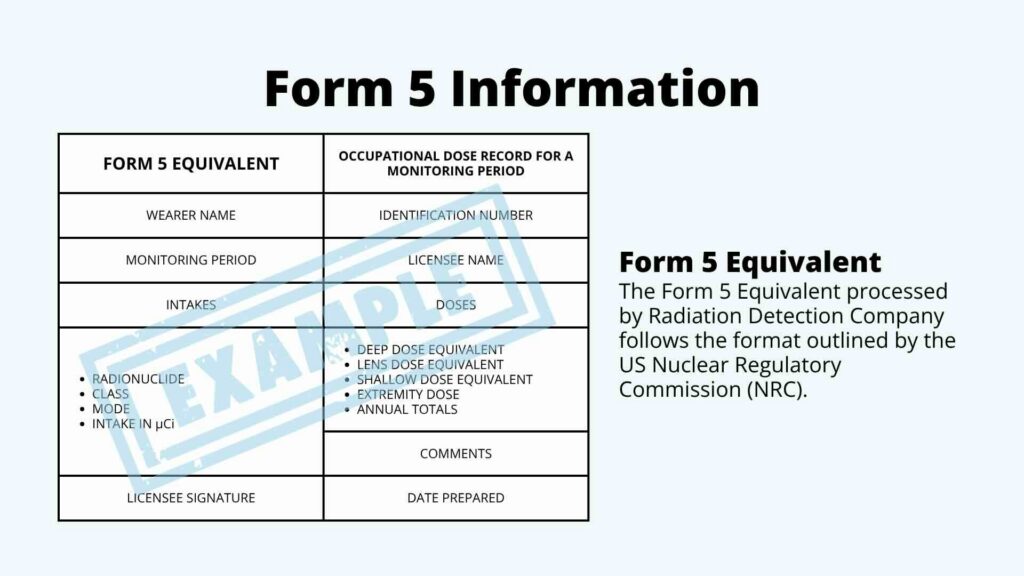
Radiation Form 5 is the official annual summary of a worker’s occupational radiation exposure. It compiles dose data collected throughout the year from personal dosimetry devices and presents it in a standardized format used across radiation safety programs.
The report includes measurements such as deep dose equivalent, lens dose, shallow dose, and any separately monitored extremity dose – values that are derived from routine radiation monitoring.
From a regulatory standpoint, Form 5 exists to support compliance with agencies such as the Nuclear Regulatory Commission (NRC), OSHA, and state radiation control programs. Organizations are required to maintain these records and make them available to monitored workers, while also demonstrating how reports are distributed during inspections.
Why Form 5 Matters in a Radiation Safety Program
Form 5 is often treated as a reporting requirement, but it plays a much larger role operationally.
At a basic level, it provides a clear and consistent way to document annual exposure and confirm that workers remain within regulatory dose limits. More importantly, it creates a record that can be reviewed over time to identify trends and validate safety practices.
This becomes especially important in environments where exposure varies by role or procedure. Over time, these reports help organizations answer key questions:
Are exposure levels increasing?
Are controls working as expected?
Are certain roles consistently receiving higher doses?
Those insights are only possible when monitoring data is accurate and consistently captured – which depends heavily on the dosimetry approach being used.
Any individual who is monitored for occupational radiation exposure may receive a Form 5 report. This includes healthcare professionals, industrial workers, and researchers working with radiation sources.
The NRC regulatory requirement is more specific than many assume. A report must be provided if a worker’s annual dose exceeds 100 mrem or if they request their exposure history.
Under 10 CFR 19.13, employers are required to provide radiation dose reports to monitored workers annually or upon request, while 10 CFR 20.2206 requires licensees to submit annual dose reports to the NRC by April 30.
In practice, most organizations choose to issue Form 5 to all monitored workers each year. This simplifies compliance and avoids the need to track individual thresholds or requests.
Timing is another common point of confusion. Annual reports are typically generated after year-end once all dosimeter badge data has been processed. This often places distribution after the first quarter of the following year, allowing time for late badge returns and final dose calculations.
Organizations that formalize this process tend to be better prepared for audits. Tools like the Radiation Compliance Cheat Sheet can help standardize workflows and ensure documentation is complete.
What Happens When a Monitored Worker Leaves?
When a worker leaves an organization, radiation exposure reporting requirements do not stop.
In many cases, a Form 5 Termination report is generated to document the worker’s exposure up to their separation date. This report may satisfy annual reporting requirements depending on timing. If not, a standard annual Form 5 may still be required.
For organizations with staff turnover or multi-site operations, having a clear process for termination reporting is essential to ensure compliance and maintain a complete exposure history.
Because radiation dose records are considered part of an individual’s occupational health history, transferring these records between employers may require proper authorization. Maintaining accurate and accessible records helps streamline this process when workers change roles or facilities.
What Information Is Included in Form 5?
Form 5 provides a summary of the key measurements that define a worker’s occupational radiation exposure.
The data includes deep dose equivalent, eye dose, skin dose, and extremity dose, along with identifying information and monitoring period details. The report may also indicate whether a value is measured or estimated, and can incorporate exposure from other employers if submitted in time.
These measurements are often abbreviated using standard regulatory terminology, including:
Total Effective Dose Equivalent (TEDE)
Deep Dose Equivalent (DDE)
Lens Dose Equivalent (LDE)
Shallow Dose Equivalent (SDE)
Committed Effective Dose Equivalent (CEDE)
Understanding these values helps RSOs interpret exposure levels and confirm compliance with regulatory limits.
In some cases, a dose may be listed as “ND,” or non-detectable. This indicates that the measured radiation exposure was below the minimum detection threshold of the dosimeter and is not considered a reportable dose.
The accuracy of these values depends on consistent dosimeter badge adherence and timely returns. Even small inconsistencies can affect reported dose, which is why programs that reinforce proper usage tend to produce more reliable reports.
Form 5 is often referenced alongside Form 4, and the distinction is important.
Form 5 provides the annual summary of exposure, while Form 4 serves as an employee’s cumulative record. Together, they provide both a yearly snapshot and a long-term view of occupational radiation dose.
Form 4 vs Form 5 Comparison
Feature
Form 4
Form 5
Purpose
Lifetime exposure record
Annual exposure report
Timeframe
Cumulative career dose
Calendar year dose
Generated From
Annual reports
Dosimetry monitoring data
For organizations managing employees across multiple locations or long careers, maintaining both records is essential. Platforms like MyRadCare Insights™ are helping bridge this gap by delivering centralized, exception-based reporting that gives RSOs better visibility into exposure trends across their entire program.
NRC Dose Limits and the Role of Form 5
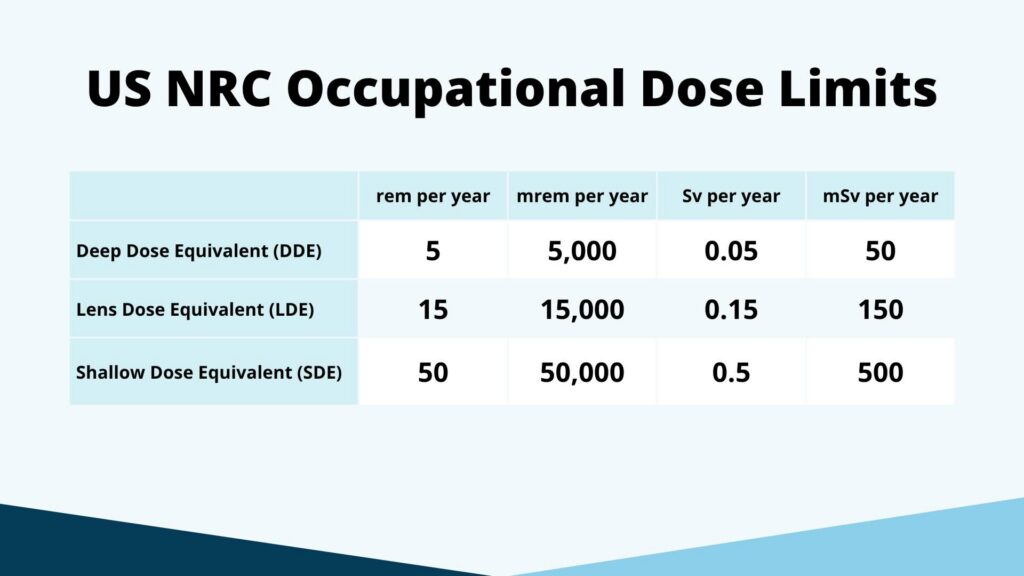
The purpose of Form 5 is closely tied to NRC occupational dose limits, which define safe exposure thresholds for radiation workers.
These limits provide a benchmark for evaluating safety performance and ensuring that exposure remains within acceptable ranges. Even though most workers operate well below these thresholds, accurate documentation is still required.
Form 5 serves as the primary mechanism for confirming that annual exposure aligns with these limits.
Recordkeeping, Distribution, and Common Challenges
Managing Form 5 is often less about the report itself and more about how it is handled.
Records must be retained for extended periods – often decades – which makes digital storage the preferred approach for most organizations. Electronic records are fully acceptable and significantly easier to manage than paper archives.
Distribution is another area where challenges arise. During inspections, organizations may be asked to demonstrate how reports are delivered and how they verify that workers received them. Without a centralized system, this can be difficult to prove.
Some organizations also encounter friction when retrieving reports, particularly if they rely on manual processes or if their dosimetry provider charges fees for access.
How RDC Simplifies Form 5 Management
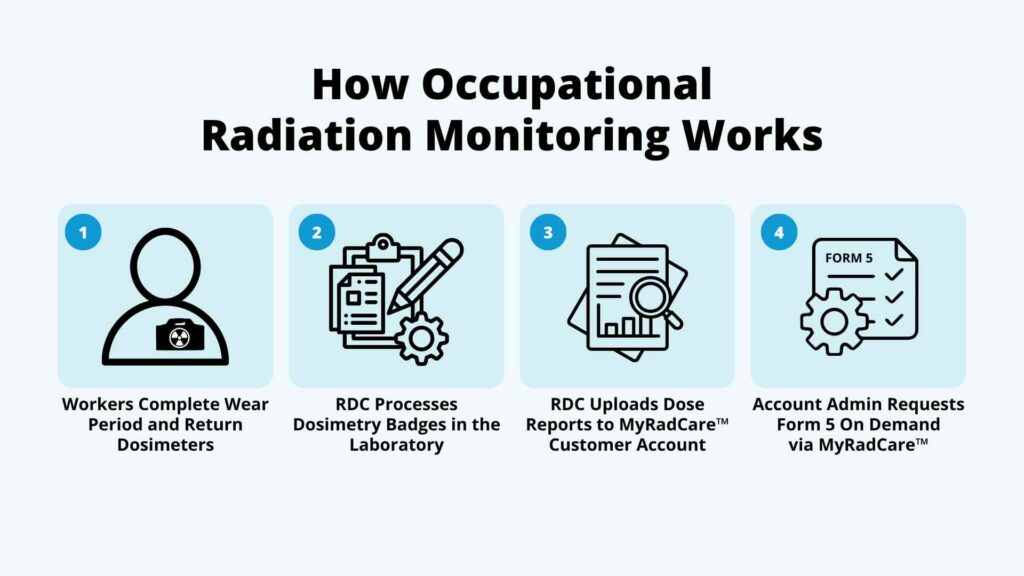
Radiation Detection Company (RDC) addresses these challenges by making dose records accessible, centralized, and easy to manage.
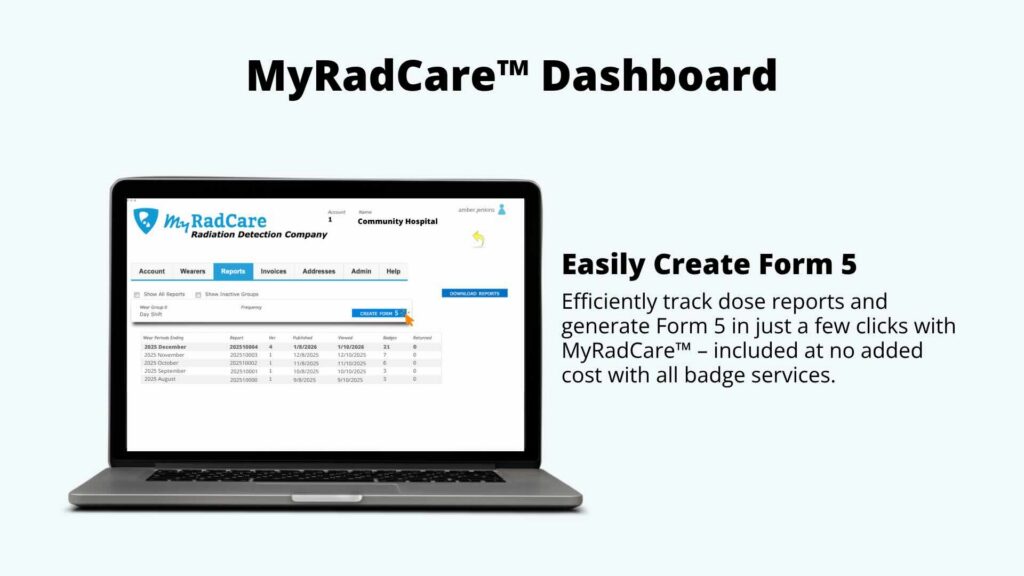
Through MyRadCare™, RDC’s cloud-based dosimetry management platform, customers can access Form 5 reports at any time, review worker exposure history, and maintain complete, organized dose records in a single system. The platform is designed to support Radiation Safety Officers and administrators by simplifying reporting, improving visibility into monitoring data, and reducing the need for manual recordkeeping.
Reports are available on demand, eliminating delays and making it easier to respond to audits, employee requests, or internal reviews. Instead of tracking records across spreadsheets or disconnected systems, organizations can rely on a centralized source of truth for occupational dose data.
Just as important as generating reports is proving they were distributed. During inspections, organizations are often asked to demonstrate that workers received their dose reports – and without a clear audit trail, this can become a compliance risk.
MyRadCare™ helps address this by enabling report tracking and visibility into previously requested and published reports. Published reports remain accessible for 72 hours, giving administrators a clear window to confirm distribution and maintain accountability, while all dose reports remain stored on the account indefinitely for long-term recordkeeping and audit readiness.
Unlike some dosimetry providers, RDC does not charge for Form 5 access. This removes a common barrier and helps organizations maintain transparent, audit-ready radiation safety programs without added administrative friction.
If you’re looking to simplify Form 5 reporting and improve visibility across your radiation safety program, submit a contact form to speak with a dosimetry specialist.
Tracking Radiation Exposure Over Time
ALARA programs rely on historical data with real time solutions to support program enhancements.
Each annual Form 5 contributes to a broader exposure history that allows organizations to monitor trends, validate controls, and ensure compliance over time. Maintaining that continuity becomes more important as workers move between roles, facilities, or employers.
Centralized systems make this process significantly easier by keeping data organized and accessible.
In cases where workers move between employers, exposure history may also be tracked through the NRC’s Radiation Exposure Information Reporting System (REIRS), which helps ensure continuity of dose records across organizations.
Simplifying Form 5 Is the Key to a Stronger Radiation Safety Program
Form 5 is a foundational element of radiation safety programs. It provides a clear, standardized summary of occupational radiation exposure and supports both compliance and long-term worker protection.
The real challenge most organizations face is managing how Form 5 is distributed, accessed, and maintained.
Organizations that modernize their monitoring programs and centralize reporting are better positioned to simplify compliance, reduce administrative burden, and maintain a stronger safety culture.
At the end of the day, Form 5 is a reflection of how well your radiation safety program is managed. When data is accurate, accessible, and consistently documented, it becomes a tool for improving safety, not just satisfying compliance.
Organizations that treat Form 5 as part of a larger, connected monitoring strategy (not a standalone requirement) are better equipped to protect their workforce, respond confidently to audits, and make smarter, data-driven decisions over time.
Existing RDC customers can access Form 5 reports anytime through MyRadCare™, eliminating delays and making dose records instantly accessible.
If your current process is slowing you down or creating compliance risk:
Form 5 is an annual occupational radiation exposure report that summarizes the radiation dose a worker received during a calendar year. It is generated from dosimetry badge data and includes measurements such as deep dose equivalent, lens dose, skin dose, and extremity exposure. The report is used to document compliance with NRC and state radiation safety regulations.
How long must Form 5 records be kept?
Form 5 records must be retained for the duration of the license, which often spans decades. In practice, many organizations maintain these records for up to 75 years to ensure a complete occupational exposure history is preserved.
Can Form 5 be stored digitally?
Yes, Form 5 records can be stored and distributed digitally. Electronic recordkeeping is widely accepted under regulatory guidelines and is often preferred because it simplifies storage, retrieval, and audit readiness compared to paper-based systems.
When should Form 5 be issued?
Form 5 is typically issued after the end of the calendar year once all dosimetry data has been processed and finalized. Many organizations distribute reports after the first quarter of the following year to account for late badge returns and ensure accurate dose calculations.
Is Form 5 required for all workers?
Form 5 must be provided to workers whose annual dose exceeds 100 mrem or upon request. However, most organizations issue the report to all monitored workers each year as a best practice to simplify compliance and maintain transparency.
What is the difference between Form 4 and Form 5?
Form 5 summarizes a worker’s radiation exposure for a single year, while Form 4 tracks cumulative exposure over time. Together, they provide both a yearly snapshot and a long-term record of occupational radiation dose.
Do employees need to sign Form 5?
Regulations require radiation dose records to include appropriate certification, which may involve a signature or equivalent validation. While requirements can vary by state, many organizations standardize review and sign-off processes to ensure consistency and audit readiness.
What happens if an employee leaves before Form 5 is issued?
If a worker leaves during the year, a termination report may satisfy reporting requirements depending on timing. If not, an annual Form 5 may still need to be provided to ensure the worker has a complete record of their occupational exposure.
Are Form 5 reports confidential?
Yes, Form 5 reports contain personal radiation exposure information and should be handled in accordance with employer privacy policies and applicable regulations. Access is typically limited to authorized personnel and the individual worker.
How can organizations simplify Form 5 management?
Organizations can simplify Form 5 management by using centralized, cloud-based dosimetry platforms that automate reporting, store exposure records, and make reports accessible on demand. This reduces administrative burden while improving compliance and audit readiness.
Ready to Simplify Your Radiation Safety Program?
Join 41,000+ organizations who trust Radiation Detection Company for accurate, timely, hassle-free radiation monitoring service.












 Previous