
TLD vs. OSL Performance: NVLAP-Accredited Lab Data on Fade, Reread, and Environmental Stress




Written by
Chris Passmore, CHP
President, Radiation Detection Company
Last Updated: May 28, 2026
Most TLD vs. OSL comparisons rely on simplified marketing claims or outdated detector data. This report compares modern LiF:Mg,Cu,P TLD and BeO OSL using performance data from RDC’s NVLAP-accredited laboratory (Lab Code 100512-0), including fade, lower limit of detection, reread performance, and tissue equivalence.
Key Takeaways
- Modern commercial TLD (LiF:Mg,Cu,P) is a different material from legacy TLD-100 – and performs far closer to OSL than most comparisons suggest
- Both TLD and OSL dosimeters from Radiation Detection Company (RDC) achieve fade rates below 3-4% per year, supporting long and multi-year wear periods
- OSL rereads are only meaningful if the reader depletion is negligible, or a depletion correction is applied
- Lower limit of detection must be measured over the actual wear period; one-day LLD figures don't reflect 30-day, 60-day, or 90-day performance
- TLD and OSL technologies from RDC are both tissue equivalent, meaning field readings closely reflect actual worker dose without complex algorithms or filtration
Why the TLD vs. OSL Debate Usually Misses the Point
Most “TLD vs. OSL dosimeter” debates focus on comparing the side-by-side specifications. We’re taking a more scientific approach to compare specific performance data: real fade curves measured over realistic wear periods, lower limit of detection tested at 30 days rather than one hour, or reread depletion data from a controlled stimulation study.
Need more support in determining which dosimeter badge will work for your organization? We’re here to help. Contact Radiation Detection Company to speak directly with a dosimetry specialist.
The TLD Technology Gap Nobody Talks About
Thermoluminescent dosimeters (TLD) include a wide range of detector materials with meaningfully different performance characteristics. Understanding the distinction is essential before any performance comparison can be made honestly.
Legacy TLD-100 (LiF:Mg,Ti) differs significantly from modern LiF:Mg,Cu,P materials used in current commercial dosimetry systems. TLD-100 is no longer used in whole body dosimetry by any major commercial processor in the United States.
Copper-doped lithium fluoride TLD dosimeters are fundamentally different than TLD-100, with a substantially improved performance profile: lower fade rates, better lower limits of detection, and better energy response.
This distinction matters because most TLD vs. OSL comparisons implicitly or explicitly compare legacy TLD-100 performance against modern optically stimulated luminescence dosimeters (OSL), a comparison that is both outdated and misleading. To understand what TLD can actually do, you need to look at LiF:Mg,Cu,P data.
For a full explanation of TLD technology and the differences between formulations, see our thermoluminescent dosimeter guide.
Fade: What the Numbers Actually Show
Thermal fade, the spontaneous loss of stored dose signal before readout, is one of the most commonly cited reasons to prefer OSL over TLD. The claim is that TLD fades faster, producing dose underreporting over extended wear periods. Like many generalizations, it contains a partial truth and a significant misconception.
Legacy TLD-100 (LiF:Mg,Ti) does have higher thermal fade than aluminum oxide OSL, particularly at elevated temperatures. If you are comparing TLD-100 to Al₂O₃:C OSL, the OSL advantage on fade is real.
However, modern LiF:Mg,Cu,P TLD does not have that problem. Both RDC’s copper-doped TLD and its beryllium oxide OSL achieve fade rates below 3-4% per year. At that level, fade is not a meaningful clinical or regulatory concern for standard personnel monitoring applications.
Both LiF:Mg,Cu,P TLD and BeO OSL support extended wear periods, including quarterly and annual monitoring programs under standard storage conditions. This directly contradicts the common industry claim that TLD technology is inherently limited to short wear periods.
For example, LANDAUER’s own comparison materials list a maximum wear period of only three months for TLD systems, implying that fade makes longer deployments impractical. RDC’s NVLAP-accredited fade data does not support that conclusion – modern LiF:Mg,Cu,P materials support 1-2+ year monitoring intervals within ANSI N13.11 performance limits.
The scenario where fade matters most is heat stress: extended exposure to temperatures well above normal ambient conditions, such as badges stored in vehicles, outdoor equipment, or facilities without climate control in summer months.
RDC’s fade studies show both LiF:Mg,Cu,P TLD and beryllium oxide OSL performing below 3-4% annual signal loss under normal storage conditions. Both technologies support multi-year monitoring programs within ANSI N13.11whole body performance limits.
Environmental durability is also frequently overstated in simplified TLD vs. OSL comparisons. Modern LiF,Cu,P TLD systems are substantially more stable than legacy TLD materials under normal occupational conditions, while BeO OSL systems offer additional resistance to environmental stress during extended wear and storage.
In practice, proper badge handling and storage procedures often matter more than minor differences in detector ruggedness alone.
For a detailed analysis of how summer storage conditions affect dosimeter accuracy, see our post on summer fade and heat-induced dose loss.
Lower Limit of Detection: Why the Measurement Period Matters
The lower limit of detection (LLD) represents a dosimeter’s ability to measure and report low levels of radiation exposure accurately over a given wear period. Because LLD varies depending on monitoring frequency and badge type, it is not a fixed value. A reported dose of “zero” does not always indicate the absence of exposure – it may simply mean the exposure fell below the dosimeter’s detectable threshold.
Even small amounts of radiation contribute to cumulative dose over time, making accurate LLD important for long-term monitoring programs.
For example, imagine a worker receives 9 millirem of occupational exposure per month while wearing a badge with a 10 millirem lower limit of detection. Each monthly report may record only “minimal” or “below detectable limit,” even though exposure occurred.
Over a full year, missed dose can accumulate meaningfully: 9 mrem * 12 months = 108 mrem of annual unrecorded exposure.
Ultimately, a lower LLD helps provide more precise and reliable dose reporting. RDC’s OSL badge features a 1 millirem LLD over a full 30-day wear period, one of the lowest available in the industry. That is a meaningful technical accomplishment, and it reflects the combination of detector material sensitivity, LED-based readout (which preserves signal), and the processing precision of an NVLAP-accredited laboratory (Lab Code 100512-0).
The LiF:Mg,Cu,P TLD also achieves competitive LLD performance, comparable to aluminum oxide OSL over extended wear periods. This is another area where the updated formulation closes what was once a meaningful gap between TLD and OSL.
If your facility monitors workers expected to receive doses near or below 10 millirem per month – common in dental or veterinary environments – the LLD of your dosimetry system over its actual wear period is a direct compliance variable. A badge with a 30-day LLD above your expected exposure level will report minimum detectable dose for those workers regardless of what they actually received.
OSL Rereads: The Laser vs. LED Distinction Nobody Mentions
OSL’s reread capability, the ability to process a badge more than once, is frequently cited as a decisive advantage over TLD. It is a real capability, but its practical value is more nuanced than provider comparisons typically suggest, and it depends heavily on a technical detail that rarely appears in marketing materials: how the badge is stimulated during readout.
OSL readers use either a laser or an LED to stimulate the detector element. The stimulation source determines how much of the stored signal is consumed during each read, and therefore how much is available for subsequent rereads.
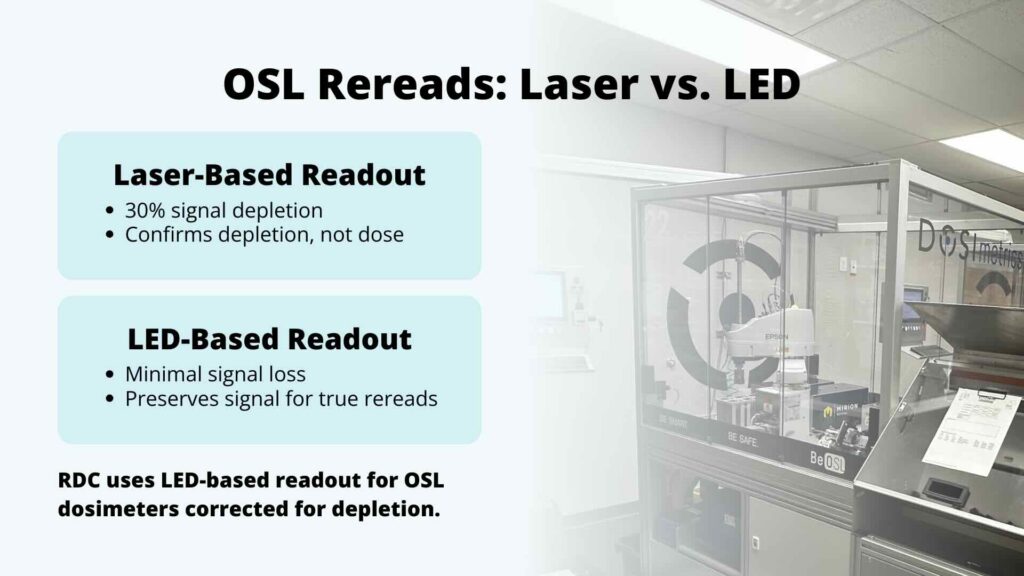
“OSL rereads are meaningful only if the reader depletion is negligible, or a depletion correction is applied. Readers that use laser as the stimulation mechanism deplete a good third of the signal at doses below 200 mrem, and there is no mechanism to correct for this depletion. At RDC, we read dosimeters using LED and also correct for depletion.” – Mirela Kirr, Senior Vice President of Operations & Technical Services
OSL reread capability depends heavily on the stimulation source used during processing. Laser-based readers can deplete a substantial portion of stored signal during the initial read, particularly at lower occupational doses, reducing the value of subsequent rereads.
LED-based systems preserve significantly more signal, allowing rereads to function as meaningful dose verification rather than simple depletion confirmation.
For a full analysis of how OSL rereads work and where their accuracy limits lie, see our post on blind spots in OSL reread accuracy.
Performance Comparison: LiF:Mg,Cu,P TLD vs. Beryllium Oxide OSL
The following table summarizes performance characteristics based on RDC laboratory data. These reflect the specific detector materials RDC uses – not generic TLD or OSL technology categories – and should not be generalized to all products marketed under those labels.
| Performance Factor | TLD (LiF:Mg,Cu,P) | OSL (BeO) |
|---|---|---|
| Detector Material | Copper-doped lithium fluoride, LiF:Mg,Cu,P | Beryllium oxide, BeO |
| Tissue Equivalence | Yes | Yes |
| Fade Rate | < 3-4% per year | < 3-4% per year |
| Long Wear Period Viability | Yes – supports 1-2+ year monitoring | Yes – RDC data extends to 3 years |
| Wear Period Options | Monthly, bi-monthly, quarterly, semi-annual, annual | Monthly, bi-monthly, quarterly, semi-annual, annual |
| Environmental Durability | Stable under standard occupational use; modern LiF,Cu,P systems tolerate typical handling and storage conditions | Durable construction resistant to moisture and temperature variation under normal occupational use |
| Sensitivity to Environmental Stress | Elevated heat exposure can increase fade if improperly stored for extended periods | Lower sensitivity to environmental stress during extended wear and storage |
| Lower Limit of Detection (LLD) at 30-day Wear | 1 mrem (0.01 mSv) | 1 mrem (0.01 mSv) |
| Minimum Reportable Dose | 1 mrem (0.01 mSv) or 10 mrem (0.1 mSv) | 1 mrem (0.01 mSv) or 10 mrem (0.1 mSv) |
| Readout Stimulation | Thermal (signal fully erased on read) | LED (minimal depletion per read) |
| Reread Capability | None | Yes, RDC uses LED to preserve >70% signal below 200 millirem; RDC corrects for depletion |
| Accreditations | NVLAP (Lab Code 100512-0); ANSI N13.11 | NVLAP (Lab Code 100512-0); ANSI N13.11 |
| Operational Cost Considerations | Comparable program cost at RDC; wear-period selection and processing workflow typically matter more than detector type | Comparable program cost at RDC; operational needs and reread requirements typically drive selection more than price |
For broader context on how TLD, OSL, and digital dosimetry technologies compare across use cases, see our guide to dosimeter types and technologies.
Tissue Equivalence: The Underrated Differentiator
Tissue equivalence describes how closely a dosimeter responds to radiation compared to human tissue.
A perfectly tissue-equivalent detector would have a response ratio of 1.0, meaning its measured response matches the absorption characteristics of human tissue exactly. A tissue-equivalent detector has an effective atomic number close to that of human soft tissue (Z ≈ 7.4). The closer a dosimeter is to tissue equivalence, the more accurately it reflects the true biological dose a worker receives.
When a dosimeter is tissue equivalent, its response to radiation, particularly at lower photon energies, closely mirrors the response of the tissue it is protecting. The practical consequence is that the dose reported by the badge closely approximates the dose actually received by the worker, without requiring elaborate energy-dependent correction filters.
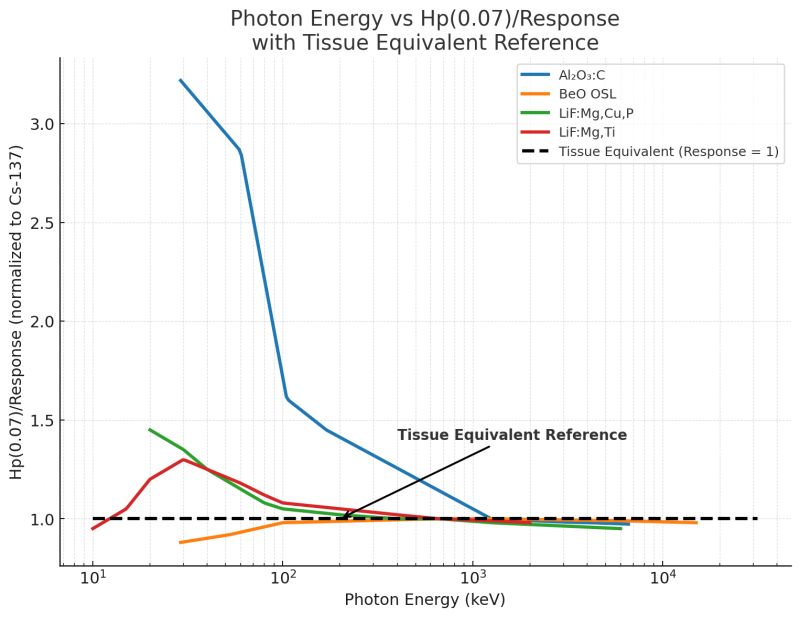
Non-tissue-equivalent detectors over- or under-respond to different photon energies. Correcting for these response variations requires complex algorithmic or physical filtration, and those corrections introduce additional sources of measurement uncertainty.
Tissue equivalence is one of the least-discussed factors in typical TLD vs. OSL comparisons. Both RDC’s LiF:Mg,Cu,P TLD and beryllium oxide (BeO) OSL are highly tissue equivalent. BeO-based OSL materials are widely regarded as among the most tissue-equivalent OSL technologies available, offering strong sensitivity with minimal energy-response correction requirements.
By contrast, aluminum oxide OSL materials such as LANDAUER’s Al₂O₃:C formulation are highly sensitive and re-readable, but they exhibit a stronger over-response at low photon energies and therefore depend more heavily on correction algorithms and filtration to achieve accurate dose estimation.
Tissue equivalency is not universal across TLD or OSL products. Material selection directly influences how closely a dosimeter tracks true biological dose under real-world radiation conditions, especially across varying photon energies.
For a deeper explanation of why tissue equivalence affects dosimetry accuracy in real-world field conditions, see our post on why tissue equivalence matters in dose measurement.
Passive Dosimeters vs. Active Dosimeters: An Important Distinction
Some OSL providers also promote features such as emergency readout capability or motion-based exposure interpretation. These capabilities can provide useful forensic information after a suspected exposure event, particularly because OSL readout is non-destructive and the badge can be reread multiple times.
However, passive OSL dosimeters should not be confused with active electronic dosimeters. Neither passive TLD nor OSL badges provide real-time alarming, continuous telemetry, live dose rate display, or immediate wearer notification during an exposure event.
In practice, “emergency readout” for passive OSL means expedited laboratory processing after the event has already occurred – not instantaneous field awareness. Likewise, motion-analysis features in some OSL systems are based on post-processing interpretation of exposure patterns rather than live monitoring.
For organizations that require immediate operational awareness, live alarming, or instant exposure assessment during high-risk procedures, real-time dosimetry, electronic personal dosimeters (EPDs), or semi-passive digital dosimeters are the appropriate technology category.
Passive dosimeters and real-time dosimetry solve different radiation safety needs:
- Passive dosimeters provide the legal occupational dose of record with excellent long-term stability and sensitivity.
- Real-time dosimetry provides immediate situational awareness and operational dose management.
NetDose™ digital dosimeter is a semi-passive solution that combines NVLAP-accredited compliance (Lab Code 600295-0) with down-to-hourly exposure visibility.
Why Processor Quality Matters More Than Badge Type
Throughout this report, the performance figures cited are specific to RDC’s processing. That specificity is intentional: the same badge design, processed by two different laboratories with different quality systems, can produce meaningfully different accuracy outcomes.
Processor quality often has a greater impact on dosimetry accuracy than badge type alone. NVLAP accreditation validates that a processor meets ANSI N13.11 performance requirements through independent testing. RDC is NVLAP-accredited (Lab Code 100512-0).
Not every dosimeter can serve as a legal dose of record. To meet regulatory requirements, the dosimeter must be processed by a NVLAP-accredited laboratory.
Under NRC 10 CFR 20.1501(c), the US Nuclear Regulatory Commission (NRC) requires licensees to use personnel dosimetry that is processed and evaluated by a dosimetry processor that:
- Maintains current accreditation through the National Voluntary Laboratory Accreditation Program (NVLAP), administered by the National Institute of Standards and Technology (NIST); and
- Holds accreditation for the radiation type that most closely matches the exposure being monitored.
Before evaluating TLD vs. OSL, ask your current or prospective provider: “Do you hold current NVLAP accreditation? Can you share your most recent ANSI N13.11 performance test results?”
Radiation Detection Company maintains NVLAP accreditation under Lab Code 100512-0, and dose reports are uploaded to the MyRadCare™ customer portal within six days of badge receipt to help keep compliance records accurate and up to date.
Practical Guidance: How to Evaluate Dosimetry Technology for Your Program
- If your program uses extended wear cycles, request data specific to your anticipated wear period.
- If rereads matter to your program, ask whether the provider uses laser or LED OSL stimulation.
- If your workers are in environments with variable photon energies, tissue equivalence should be an explicit evaluation criterion.
- If you are evaluating long wear periods or infrequent badge exchange, ask for fade data measured at the intended wear duration, not annual figures extrapolated from shorter studies.
For a broader view of monitoring program structure, wear period selection, and compliance considerations, see our complete dosimetry program management guide.
Methodology: How This Data Was Generated
Performance measurements referenced in this report were generated at RDC’s NVLAP-accredited dosimetry processing laboratory (Lab Code 100512-0). All calibration sources are traceable to NIST standards. Processing follows documented quality system requirements consistent with ANSI N13.11. Data has been reviewed and validated by Chris Passmore, CHP.
TLD vs. OSL: The Evidence-Based Answer
Modern LiF:Mg,Cu,P TLD and BeO OSL dosimeters perform far more similarly than many traditional comparisons suggest. The most meaningful differences in occupational dosimetry accuracy often come from processor quality, accreditation status, wear-period testing methodology, and OSL readout design rather than badge category alone.
What the data shows, specifically, is:
- Modern LiF:Mg,Cu,P TLD greatly outperforms legacy TLD-100.
- OSL rereads are only meaningful if the stimulation source preserves enough signal to verify.
- LLD claims mean nothing without a wear-period qualifier.
- Tissue equivalence defines accuracy: the closer a detector’s response is to tissue, the more reliable the dose measurement.
Ready to Evaluate Your Dosimetry Program?
Contact RDC to speak with a dosimetry expert →
Download the Ultimate Radiation Badge Guide →
Frequently Asked Questions
What is the real accuracy difference between TLD and OSL dosimeters?
Modern LiF:Mg,Cu,P TLD dosimeters perform similarly to BeO OSL dosimeters in fade resistance, tissue equivalence, and lower limit of detection. Comparisons that show large performance gaps often reference older TLD-100 technology rather than current commercial TLD materials.
Which is more accurate: TLD or OSL?
Modern LiF,Cu,P TLD and BeO OSL dosimeters can both achieve highly accurate occupational dose measurement when processed properly by an NVLAP-accredited laboratory.
Processor quality, calibration methodology, tissue equivalence, wear-period validation, and environmental conditions often have a greater impact on real-world accuracy than whether the detector is categorized as TLD or OSL.
Can TLD and OSL dosimeters be reread or reused?
Both TLD and OSL dosimeters can be reused for future monitoring periods after processing, but they differ significantly in reread capability.
TLD readout is destructive: during processing, heat releases and erases the stored radiation signal, meaning the same occupational exposure cannot be reread afterward.
OSL dosimeters differ because optical stimulation removes only part of the stored signal during readout, allowing rereads when appropriate depletion correction methods are used. RDC uses LED-based OSL processing and applies depletion correction to preserve meaningful reread capability.
How long can you wear a TLD vs. OSL badge?
Dosimeter replacement frequency depends on monitoring objectives, regulatory requirements, detector technology, expected exposure levels, and processor validation data.
Modern LiF,Cu,P TLD and BeO OSL systems support extended monitoring intervals under standard storage conditions. RDC’s NVLAP-accredited fade data supports quarterly, annual, and multi-year monitoring applications for both technologies.
What is the lower limit of detection (LLD) for a dosimeter?
Lower limit of detection (LLD) is the lowest dose a dosimeter can report accurately over a period of time. Request LLD data specific to your wear period when evaluating any dosimetry provider.
What is dosimeter fade?
Dosimeter fade is the loss of stored radiation signal before processing. Excessive fade can cause underreported dose measurements. Modern LiF:Mg,Cu,P TLD and BeO OSL systems both demonstrate low annual fade under standard storage conditions (less than 3-4% per year under normal conditions).
What is tissue equivalence, and why does it matter?
Tissue equivalence describes how closely a detector responds to radiation compared to human tissue. A tissue-equivalent dosimeter produces dose measurements that more accurately reflect exposure, without requiring complex energy-response correction algorithms.
Not all dosimeters marketed as TLD or OSL share this characteristic; both RDC’s LiF:Mg,Cu,P TLD and beryllium oxide OSL are tissue equivalent.
What is the difference between Al₂O₃:C and BeO OSL materials?
Aluminum oxide (Al₂O₃:C) and beryllium oxide (BeO) are different OSL detector materials with different performance characteristics.
Al₂O₃:C offers extremely high sensitivity and strong reread capability but exhibits greater over-response at lower photon energies because it is less tissue equivalent.
BeO OSL materials are more tissue equivalent and provide energy response characteristics that more closely match human tissue, reducing dependence on correction algorithms and filtration. BeO also supports strong fade performance and extended wear applications.
How do I know if my dosimetry provider is accurate?
NVLAP accreditation verifies that a dosimetry processor meets ANSI N13.11 performance requirements through independent laboratory testing. Accredited processors can provide legally recognized occupational dose records; accreditation status is also publicly verifiable through the NVLAP database.
Radiation Detection Company (RDC) is NVLAP-accredited, Lab Code 100512-0.



 Previous