This guide explains the differences between thermoluminescent dosimeters (TLDs), optically stimulated luminescence dosimeters (OSLs), and semi-passive solutions like NetDose™, helping organizations determine which radiation dosimeter best fits their safety program. Learn how each dosimeter works, where it performs best, how to meet NRC and state compliance requirements, and what factors most influence program cost, staff confidence, and reporting efficiency.
Radiation safety is more than a regulatory requirement: it’s a cornerstone of protecting healthcare workers, veterinarians, dental professionals, researchers, and industrial technicians who work with ionizing radiation every day. For organizations across these fields, choosing the right radiation dosimeter is a critical decision that directly impacts staff safety, compliance, and operational efficiency.
But with multiple technologies available, from thermoluminescent dosimeters (TLDs) to optically stimulated luminescence dosimeters (OSLs), and semi-passive solutions like NetDose™ that provide on-demand digital reporting, the question becomes: which one is right for your team?
This comprehensive guide consolidates the latest insights and decades of expertise to help you evaluate dosimeter types, compare their strengths and limitations, and make an informed decision. Whether you’re overseeing a hospital radiology department, a rural dental practice, or a nuclear component manufacturing facility, this article provides the clarity you need.
Key Takeaways
Radiation dosimeters fall into three categories: passive (TLDs, OSLs), semi-passive (NetDose™), and active. Each dosimeter type measures radiation exposure but differs in reporting speed, re-readability, and administrative impact.
Only NVLAP-accredited dosimetry solutions provide the legal dose of record under NRC and state regulations; active dosimeters are supplemental tools for high-risk nuclear settings, not stand-alone compliance solutions.
The best dosimeter for your environment depends on your needs: consider the type of radiation used, cost efficiency, special compliance considerations, and reporting speed.
Your choice impacts staff trust and program efficiency: quicker access to results and the ability to verify dose history with accurate reporting can reduce anxiety, improve safety culture, and simplify compliance administration.
What Is a Radiation Dosimeter?
At its core, a radiation dosimeter (or badge) is a device worn by workers to measure ionizing radiation exposure over time. The results provide a legal dose of record, which regulatory agencies require to demonstrate compliance with occupational safety standards.
Worker safety: Dosimeter badges ensure employees are not exceeding occupational dose limits within a designated wear period.
Compliance: Occupational radiation monitoring is required by the Nuclear Regulatory Commission (NRC), Occupational Safety and Health Administration (OSHA), and state regulatory agencies.
Audit readiness: A robust radiation safety program provides documented proof of safe practices.
Types of Dosimetry Approaches
Radiation dosimeters can be grouped into three categories.
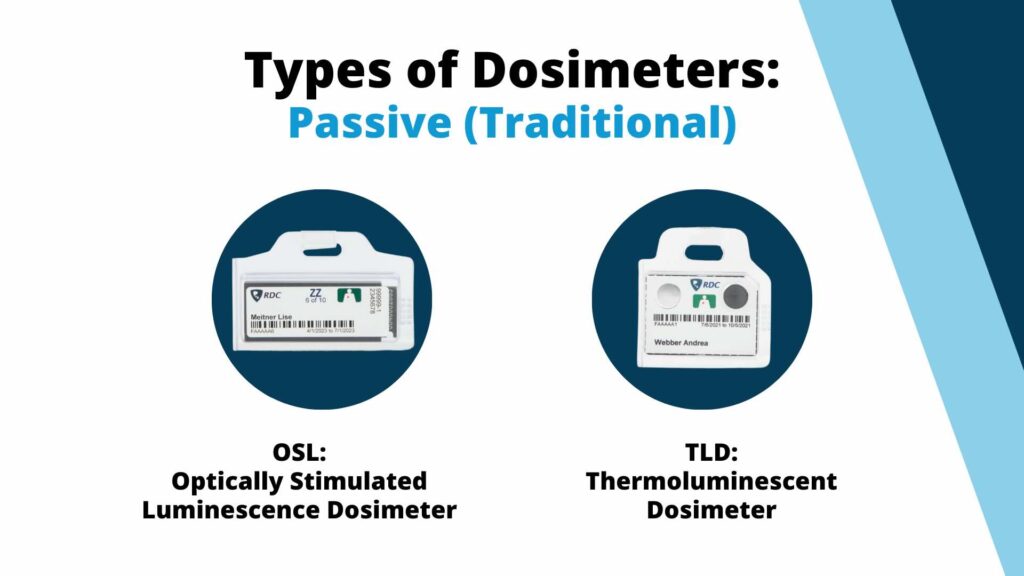
Passive Dosimeters
How they work: Record radiation silently during a monitoring period (typically 1-3 months)
Reporting: Require laboratory processing before results are available
Examples: TLD, OSL, TLD + Neutron
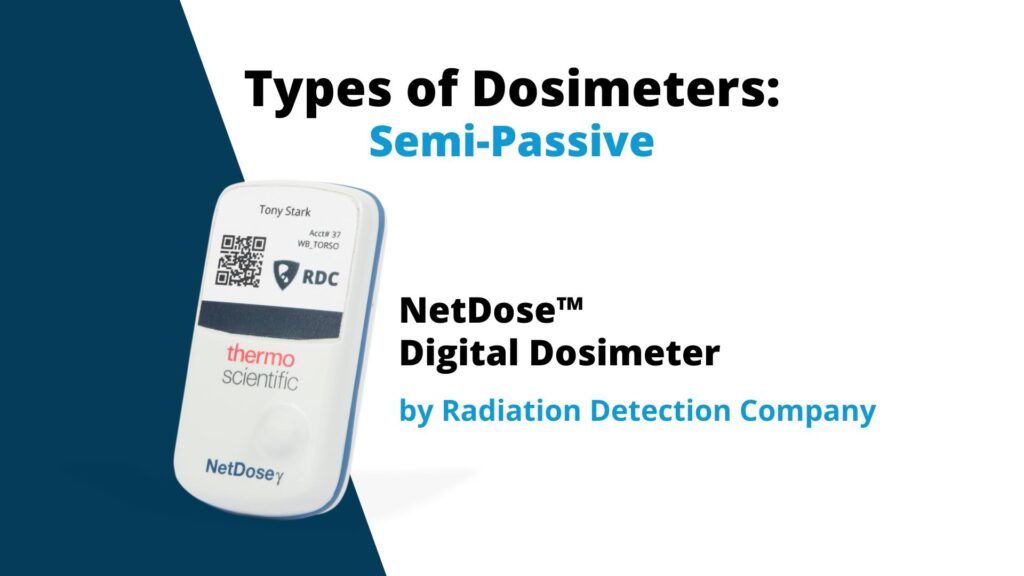
Semi-Passive Dosimeters
How they work: Combine the simplicity of passive dosimeter badges with faster, digital data delivery
Reporting: Provide on-demand, down-to-hourly reporting through digital platforms, giving timely compliance visibility without requiring instant on-device alarms
Examples: NetDose™ digital dosimeter by Radiation Detection Company
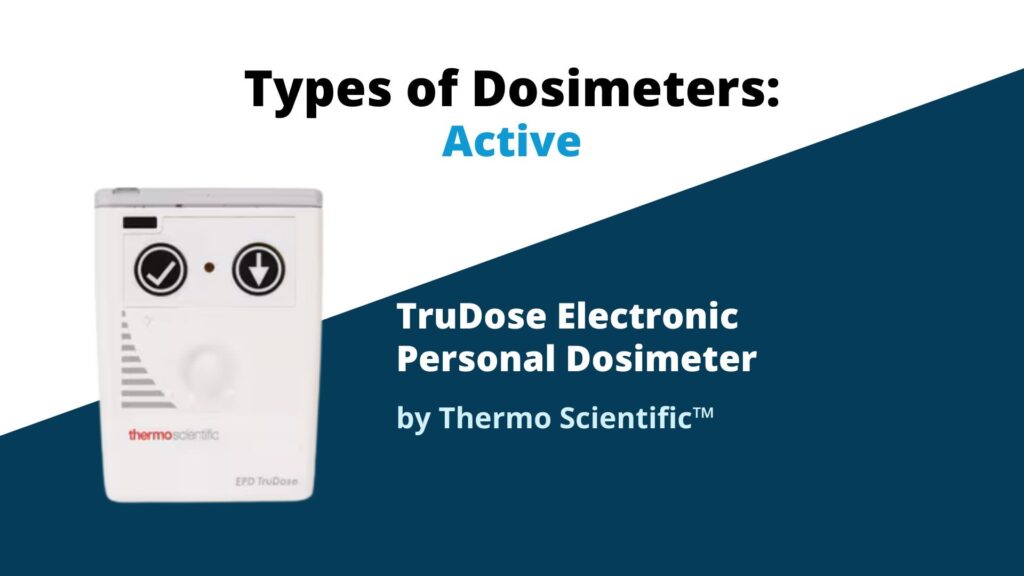
Active Dosimeters
How they work: Provide instant on-device readouts and alarms
Use case: Primarily used in nuclear sites or environments handling radioactive materials, where immediate alarms are essential
Here’s a high-level comparison of the four main technologies:
Dosimeter Type
How It Works
Advantages
Limitations
TLD
Crystal stores radiation energy, released as light when heated in a lab
Proven, cost-effective, durable, reliable
One-time readout, delayed results, limited reuse
OSL
Laser light releases stored energy, re-readable multiple times
High sensitivity, durable, re-readable
Requires laboratory processing
Semi-Passive (NetDose™ Digital Dosimeter)
Bluetooth-enabled dosimeter with on-demand insights (down to hourly)
Near real-time data, cloud-based reporting, compliance-ready, reduced admin burden
Requires Bluetooth syncing via an app
Active Dosimeters
Electronic sensors provide instant alarms and on-device readouts
Real-time alarms, immediate feedback, essential in nuclear applications
Higher cost, often unnecessary for most industries; not a valid replacement for passive dosimetry
Thermoluminescent Dosimeters (TLDs)
How TLDs Work
TLDs contain crystalline material (commonly lithium fluoride). When exposed to radiation, electrons within the crystal become “trapped” in higher energy states. Later, in a lab, the dosimeter is heated, releasing the trapped energy as visible light. The intensity of this luminescence is proportional to the radiation dose.
At Radiation Detection Company, we’ve chosen LiF:Mg,Cu,P as the detector material in our TLD dosimeters because it’s close to tissue equivalent.
Advantages of TLDs
Proven technology: Decades of use worldwide
High sensitivity: Detects doses as low as 1 mrem (.01 mSv)
Regulatory acceptance: Universally recognized as a reliable dose of record
Limitations of TLDs
One-time analysis: During the reading process, the entire signal gets depleted, which does not allow for re-readability
Delayed feedback: Organizations cannot see results until after the exchange cycle
Wear-and-tear: Crystals degrade with repeated use
Typical Applications
TLDs are an excellent choice for nuclear power plants, research universities, and medical centers where the radiation work permit includes monitoring for beta, photon, and neutron radiation.
OSLs use a similar principle to TLDs but release release energy when stimulated with a laser or light emitting diode (LED) instead of heat. This process is non-destructive, allowing the dosimeter badge to be reread multiple times for verification or audits.
At Radiation Detection Company, we use beryllium oxide (BeO) as the detector material in our OSL dosimeters because it’s the most tissue-equivalent material.
Advantages of OSLs
High sensitivity: Detects doses as low as 1 mrem (.01 mSv), same as TLDs
Re-readable: Perfect for investigations, audits, or disputed dose reports
Durability: Resistant to heat, humidity, and environmental stressors
Limitations of OSLs
Still passive: No immediate data for workers
Typical Applications
OSLs are the gold standard for facilities prioritizing accuracy, durability, and verification capability. They are ideal for organizations relying on photon radiation only – whether in a healthcare, dental, veterinary, research, or industrial environment – where audits and dose verification are routine.
Semi-Passive Digital Dosimeters: The Evolution of Monitoring
How Semi-Passive Dosimeters Work
For simplicity’s sake, we’ll use NetDose™ as our semi-passive dosimeter example. Unlike traditional passive dosimeter badges that require a full cycle of lab processing, NetDose™ provides digital reporting in near real time. Data can be delivered on demand, with results available down to the hour through secure digital platforms.
Advantages of NetDose™
On-demand reporting: Down-to-hourly data supports timely compliance and operational visibility
Compliance-ready: Provides the legal dose of record accepted by regulators
Administrative efficiency: Reduces delays of traditional passive dosimeters
Scalable: Ideal for multi-department hospitals, IDNs, and industrial facilities
Limitations of NetDose™
Not a true active device: Does not provide instant on-device alarms during wear
Still requires syncing: RSOs and wearers will have to manually sync each NetDose™ digital dosimeter to upload data for dose reports
NetDose™ and Declared Pregnant Employees
Radiation safety becomes even more personal when it involves declared pregnant employees. Traditionally, staff in this category have had to wait weeks or months for TLD or OSL results to be processed, creating unnecessary anxiety and limiting the ability to make timely adjustments to work practices.
NetDose™ addresses fetal monitoring gaps by providing on-demand, down-to-hourly dose reports. This gives pregnant employees (and their supervisors) peace of mind, ensuring they can track exposure more closely and maintain confidence in their safety throughout the pregnancy.
Typical Applications
Semi-passive dosimeters like NetDose™ are best suited for organizations that require photon monitoring (X-ray, gamma) and want fast, regulator-approved reporting and a reduced administrative burden, without the complexity of active alarms. NetDose™ is ideal for pregnant employees who would benefit from on-demand reporting for greater insight and more peace of mind.
Active Dosimeters
How Active Dosimeters Work
Active dosimeters use electronic radiation detectors (typically Geiger-Müller tubes, silicon diodes, or ionization chambers) to measure exposure in real time during the wear period. Unlike passive or semi-passive badges that require processing or syncing to generate reports, active dosimeters provide instantaneous readings directly to the wearer.
However, active dosimeters are not NVLAP-accredited and cannot serve as the legal dose of record. Instead, they function as supplemental safety tools for environments where immediate awareness of exposure is critical. In some environments, active dosimeters may be required alongside a NVLAP-approved passive dosimeter, which provide the legal dose of record.
Most active dosimeters are equipped with:
Audible and visual alarms that alert the user when dose or dose-rate thresholds are exceeded
On-device displays showing accumulated dose, dose rate, and sometimes time/date of exposure
Internal memory and logging for short-term trend tracking (but not compliant reporting)
Advantages of Active Dosimeters
Real-time data: Provides immediate dose and dose-rate feedback during exposure
Alarm features: Alerts workers instantly when preset thresholds are reached
Situational awareness: Helps users take protective action in dynamic or unpredictable radiation fields
Limitations of Active Dosimeters
Not approved as the legal dose of record: Must be paired with passive or semi-passive NVLAP-accredited dosimeters
Higher cost: Often more expensive upfront due to electronics and device maintenance
Not needed in most workplaces: Typically overkill in photon-only healthcare and industrial settings
Battery-dependent: Requires charging or battery replacement
Typical Applications
Active dosimeters are used primarily in high-risk radiation environments where instantaneous feedback can prevent acute overexposure. They are most appropriate for:
Nuclear power plants
Radiopharmaceutical manufacturing
Isotope production facilities
High-energy research laboratories
Hot labs or environments with significant dose-rate fluctuation
In these settings, the ability to alarm in real time helps protect personnel from unexpected dose spikes.
Active dosimeters are typically overkill for most healthcare, dental, veterinary, and industrial users, but necessary for high-risk nuclear applications. They do not provide a legal dose of record and only act as a complement to NVLAP-approved dosimeters.
Technical Deep Dive: TLD, OSL, Semi-Passive, and Active Dosimeters
For radiation safety officers (RSOs) and compliance leaders, the decision often comes down to sensitivity, verification, reporting speed, and administrative efficiency. Here’s how the main dosimetry technologies compare:
Feature
TLD
OSL
NetDose™ (Semi-Passive)
Active Dosimeter
Radiation Measured
X-ray, Beta, Gamma, Neutron
Gamma and X-ray
Gamma and X-ray
Varies by model
Minimum Reportable Dose
10 mrem (0.1 mSv); down to 1 mrem by client request
To simply things, here's a summarized interpretation of the table above:
TLDs and OSLs are budget-friendly and highly sensitive; RDC utilizes tissue-equivalent material for the entire passive dosimetry fleet. These dosimeters respond to radiation in a very similar way the body responds to radiation allowing for higher precision in dose calculation.
NetDose™ bridges the gap with digital, near real-time reporting and tissue equivalency that meets compliance needs for hospitals, clinics, industrial facilities, and pregnant employees across all industries – without requiring instant alarms.
Active dosimeters remain necessary only in nuclear and high-exposure scenarios, not for most healthcare or industrial organizations. Active dosimeters alone cannot be used as an official dose of record; they are a supplement to required passive dosimeters, primarily used for real-time monitoring and alarming functions.
Regulatory Context
Ultimately, every organization is responsible for choosing the dosimetry solution that meets the regulatory requirements for their industry. Below is a generalized summary of the most common regulatory agencies that oversee radiation monitoring.
US Nuclear Regulatory Commission (NRC)
From a dosimetry perspective, the NRC sets the federal requirements for radiation protection – defining dose limits, when workers must be monitored, and how exposure records must be kept and reported (e.g., under 10 CFR Part 20). It then licenses and inspects its regulated facilities and materials users, enforcing these requirements and ensuring worker and public doses remain within regulatory limits.
The NRC accepts NVLAP-accredited TLD, OSL, and semi-passive systems such as NetDose™ as the legal dose of record (RDC NVLAP Lab Code 100512-0, NetDose™ NVLAP Lab Code 600295-0). The NRC does not allow active dosimeters to serve as the sole monitoring solution for a legal dose of record.
Occupational Safety and Health Administration (OSHA)
From a dosimetry perspective, OSHA sets and enforces workplace safety standards for ionizing radiation exposure, which include dose limits, area posting, personal monitoring, training, and record-keeping requirements for employers. OSHA also inspects workplaces, cites violations, and requires corrective actions to ensure employers are monitoring workers appropriately.
OSHA enforces workplace safety standards but defers to the NRC and state-level agencies for radiation exposure requirements.
State Regulators
State regulators set and enforce rules for the use of X-ray machines and radioactive materials, including when and how workers must be monitored with dosimetry and how exposure records are maintained. They inspect facilities for compliance with these requirements, investigate overexposures, and align their programs with federal standards (e.g., NRC) to ensure adequate protection of workers and the public
Some states specify badge exchange intervals (e.g., monthly vs. quarterly), which may influence whether a program selects TLDs, OSLs, or NetDose™.
Healthcare Joint Commission
The Healthcare Joint Commission increasingly emphasizes timely, auditable dose reporting, encouraging hospitals and imaging centers to consider solutions that reduce reporting lag and support proactive oversight. From a dosimetry perspective, The Joint Commission (TJC) doesn’t set dose limits but drives how hospitals manage and monitor patient and staff radiation dose as part of accreditation.
Cost Considerations: TLD vs. OSL vs. NetDose™
When evaluating dosimetry solutions, cost is understandably a deciding factor – every organization is under pressure to do more with less. Still, it’s important to look beyond the unit price of each dosimeter badge and consider the total program cost, including administrative effort, reporting needs, and compliance requirements.
While we can’t speak to other dosimetry providers, here are some cost considerations in relation to Radiation Detection Company (RDC). Calculate your dosimeter badge cost by badge type and wear cycle, or call 800.250.3314 for a personalized estimate.
Same cost structure: Both TLDs and OSLs are priced equally at RDC.
Built-in discounts: Tiered discounts apply automatically as order volumes increase (for example, every 10 dosimeters ordered).
Accessible for all program sizes: Solo practitioners and small clinics (average orders are just a handful of dosimeter badges) benefit from affordability and simplicity, while larger hospitals and research labs value the compliance-ready performance.
Program fit: TLDs remain trusted for stable, predictable environments like dental or veterinary practices, while OSLs add re-readability and archival options for programs that prioritize verification and auditing.
NetDose™ (Semi-Passive Digital Dosimeter)
Higher upfront investment due to digital processing and platform integration.
Offset by efficiency gains: Faster reporting, reduced administrative burden, and digital compliance records can translate into long-term savings.
Best fit: High-risk environments where timely reporting and oversight are critical, and pregnant employees who would benefit from greater insights for peace of mind.
Enterprise Pricing Advantage
Enterprise organizations receive significant high-volume discounts, making RDC highly competitive in the market. While published unit pricing is transparent for small practices, enterprise buyers should know that pricing scales to reflect program complexity, dosimeter badge volume, and long-term partnerships.
Real-World Dosimetry Applications Across Industries
Choosing the right dosimeter depends first and foremost on what types of radiation are present in your environment – beta, photons (X-ray, gamma), or neutron – and whether your program needs re-readability, audit support, or faster reporting. Below is practical guidance for each industry based on those factors.
Hospitals & Healthcare
Primary radiation types: Photons (X-ray, gamma). Some departments may involve beta, depending on procedures or isotopes used.
OSLs (Recommended)
OSL dosimeters are strongly recommended for hospitals and healthcare environments because they can be re-read and archived, supporting incident investigations, audit requirements, and regulatory documentation. Re-readability is independent of hospital size – it is a best practice for all healthcare programs where verification matters.
TLDs
Appropriate when beta radiation is present, or in hybrid environments where multiple radiation types must be monitored. TLDs remain a reliable option but cannot be re-read, which is a limitation for audit-heavy hospital programs.
NetDose™ (Semi-Passive)
Highly beneficial in departments that need faster reporting, such as fluoroscopy, cath labs, diagnostic imaging, mobile X-ray, and for declared pregnant employees who benefit from on-demand reassurance.
Active Dosimeters
Not required for typical medical imaging or radiation therapy workflows. Used only when radioactive materials or high-risk isotopes are handled and immediate alarms are necessary. Active dosimeters cannot serve as the legal dose of record.
Dental & Veterinary Clinics
Primary radiation types: Photons (X-ray).
TLDs or OSLs (Both Appropriate)
Both TLD and OSL dosimeters are suitable because clinics historically use photon-only radiation. Choose OSL if your practice prefers the ability to re-read badges or maintain longer-term dose verification.
NetDose™
Useful in specialty veterinary or dental oncology practices that want faster reporting or more frequent exposure insights, but not required for most practices.
Active Dosimeters
Not necessary in these settings.
Industrial & Research Facilities
Primary radiation types: Photon-only, beta + photon, or beta + photon + neutron depending on facility type.
TLDs (Recommended when beta or neutron radiation is present)
If any beta radiation is present, or if beta, photons, and neutron exposure must be monitored together, TLDs are the appropriate choice. TLD materials handle these energy types reliably and maintain accuracy across varied conditions.
OSLs
Ideal for photon-only industrial environments requiring precise dose tracking and the ability to re-read badges (e.g., nondestructive testing, industrial X-ray operations).
NetDose™
Valuable in industrial programs needing enhanced operational oversight or near real-time exposure insights – such as aerospace manufacturing, electronics inspection, or nuclear component production – where streamlined compliance workflows reduce risk.
Active Dosimeters
Reserved for nuclear power plants, isotope production facilities, or environments with significantly high-energy fields where real-time alarms are essential. Active dosimeters remain a supplement, never the official dose of record.
Which Dosimeter Is Right for You?
Each dosimetry technology has its place; the right choice depends on your program’s risk profile, compliance requirements, and administrative needs.
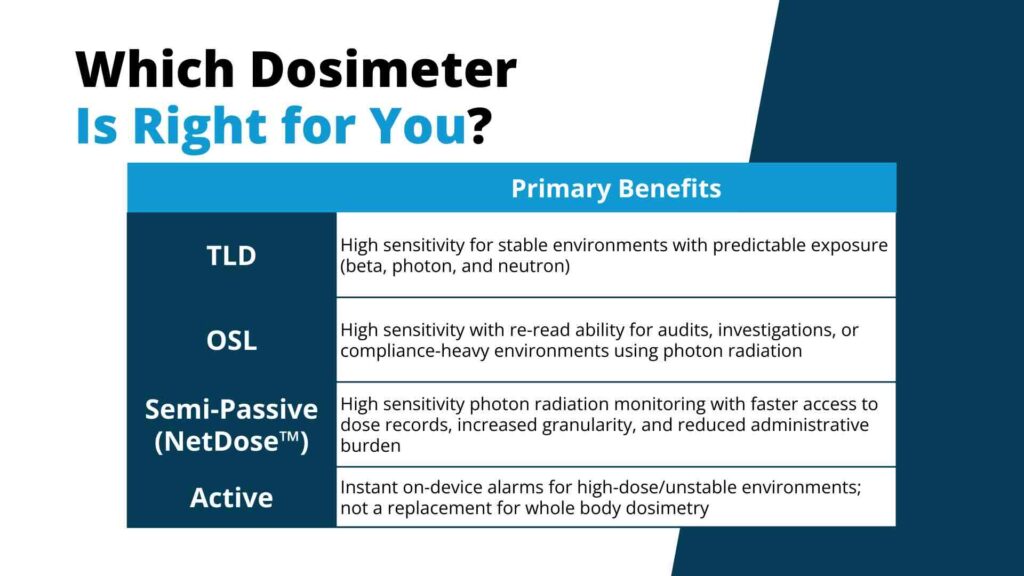
Choose TLDs if you want a high sensitivity solution for stable environments with predictable exposure (beta, photon, and neutron). TLDs remain a trusted standard in dental, veterinary, and many healthcare and industrial settings.
Choose OSLs if you need high sensitivity and the ability to re-read dosimeter badges for audits, investigations, or compliance-heavy environments using photon radiation. OSLs are a strong fit for hospitals and labs where precision and verification matter.
Choose Semi-Passive Dosimeters if you use photon radiation and want faster access to dose records (down-to-hourly), reduced administrative burden, and digital delivery of results. NetDose™ is particularly valuable in high-risk environments or for pregnant employes – when timely reporting improves efficiency, oversight, and peace of mind.
Choose Active Dosimeters if you work in nuclear facilities or directly with radioactive materials where instant on-device alarms are critical. These scenarios are specialized and not typical for most healthcare or industrial organizations.
For most organizations, passive dosimetry (TLDs and OSLs) is the right foundation. Semi-passive solutions like NetDose™ enhance programs where speed and efficiency add value, while active dosimeters remain necessary only in highly specialized environments.
Radiation dosimetry has evolved to offer organizations more flexibility than ever before. Passive dosimeters like TLDs and OSLs remain the foundation of most monitoring programs – delivering reliable, cost-effective, and regulator-approved dose records trusted across healthcare, dental, veterinary, and industrial environments.
For organizations that require faster reporting cycles, digital delivery of records, peace of mind for pregnant employees, or reduced administrative overhead, semi-passive solutions like NetDose™ provide an excellent complement. They bridge the gap between traditional passive dosimetry and true active systems, offering near real-time reporting without unnecessary complexity.
The right choice depends on your facility’s risk profile, compliance requirements, and operational needs. In many cases, TLDs or OSLs are the best fit. In others – especially high-risk environments or programs with complex compliance requirements – a semi-passive solution like NetDose™ may deliver added value.
Either way, Radiation Detection Company is here to help. Complete our contact form now or call 800.250.3314 to speak to take the guesswork out of your dosimetry program. Radiation safety and dosimetry program management is easy when you have the right support in your corner.
Frequently Asked Questions
Are digital dosimeters replacing TLD and OSL dosimeter badges?
Not entirely. While digital adoption is growing, TLDs and OSLs remain widely used due to cost-effectiveness and familiarity.
Are digital dosimeters accepted as an NRC-approved legal dose of record?
NVLAP-accredited devices such as RDC’s NetDose™ (Lab Code 600295-0) are approved by the NRC and provide full compliance documentation. NetDose™ provides validated dose records that meet all regulatory requirements and are fully compliant with NRC and state guidelines.
How often should dosimeters be exchanged?
Exchange periods depend on your organization’s needs. Radiation Detection Company offers various exchange periods, including:
Active dosimeters do not require exchange periods because they do not provide a legal dose of record.
Can OSLs be re-read for dose investigation?
Yes. Unlike TLDs, OSLs retain stored dose data even after initial processing.
Which dosimeter is best for hospitals?
The short answer is it depends on the type of occupational radiation used. OSL is ideal for photon-only environments that might require re-reads or dose verifications. NetDose™, a semi-passive digital dosimeter, is more ideal for high-risk environments (like cath labs, mobile x-ray units, fluoroscopy, and mammography) or pregnant employees who value on-demand reporting for peace of mind.
Are active dosimeters still needed in some environments?
Yes, but only in specialized cases such as nuclear facilities or direct radioactive material handling, where instant alarms are essential. It’s important to note that active dosimeters do not provide a legal dose of record, and are meant to supplement (not replace) NRC-approved dosimetry solutions.
Ready to Simplify Your Radiation Safety Program?
Join 41,000+ organizations who trust Radiation Detection Company for accurate, timely, hassle-free radiation monitoring service.