

How Dosimetry Badge Pricing Works




Written by
Gregg Daversa, RT(R)(CT)(MR)
Director of Healthcare Sales
Last Updated: March 4, 2026
This guide explains how dosimetry badge pricing works, where dosimetry providers differ most, hidden fees to watch out for, and what questions to ask before committing to a dosimetry provider.
Dosimetry service pricing extends far beyond the per-badge rate. Most providers structure dosimetry as a subscription service, with costs shaped by badge type, wear period, reporting access, and policies around returns or replacements. For imaging providers utilizing radioactive materials or radiation-emitting modalities, understanding the full pricing structure is essential to avoiding surprise fees and selecting a program that supports long-term compliance.
If you’re researching dosimeter pricing, you’ve likely encountered a frustrating reality: providers rarely make it simple to compare programs side by side.
On the surface, most dosimetry providers present a per-badge service rate. In practice, total program cost is influenced by wear frequency, monitoring technology, reporting cadence, and administrative policies. Without clearly defined terms, additional service charges can quickly complicate what initially appeared to be a straightforward quote.
For radiation safety leaders, that uncertainty makes budgeting difficult. In hospital environments especially, badge counts fluctuate, exchange deadlines aren’t always perfect, and dose reporting timelines are directly tied to regulatory obligations. When pricing structures lack transparency, predictable budget planning can turn into reactive issue management mid-cycle.
Key Takeaways
- Dosimetry badge pricing is typically structured as a subscription service, not a one-time purchase.
- Badge type matters: traditional passive monitoring, digital dosimeters, extremity rings, and neutron-capable badges are priced differently.
- Monthly wear cycles generally cost more than quarterly due to processing frequency, increased shipping, and faster feedback.
- Unexpected program costs typically stem from provider terms around badge returns, replacements, and contract structure – not the quoted badge rate.
- The best choice balances cost transparency, customer service, and dosimeter badge and dose report accuracy – not just the lowest cost.
How Does Dosimeter Badge Pricing Work?
Most dosimetry providers begin with a per-badge baseline, but that figure is only one part of the story.
Dosimetry badges and rings are not purchased outright. Instead, they are provided through an ongoing monitoring service. Providers ship badges each wear period, process them upon return, calculate dose results, and generate the regulatory documentation organizations need for compliance.
Dosimetry pricing isn’t one-size-fits-all. A small clinic monitoring 10 workers will be structured differently from a multi-site healthcare system monitoring hundreds or thousands of personnel. Most providers use tiered pricing, where per-badge costs decrease with volume, and larger organizations often require centralized reporting, consolidated invoicing, and more complex logistics.
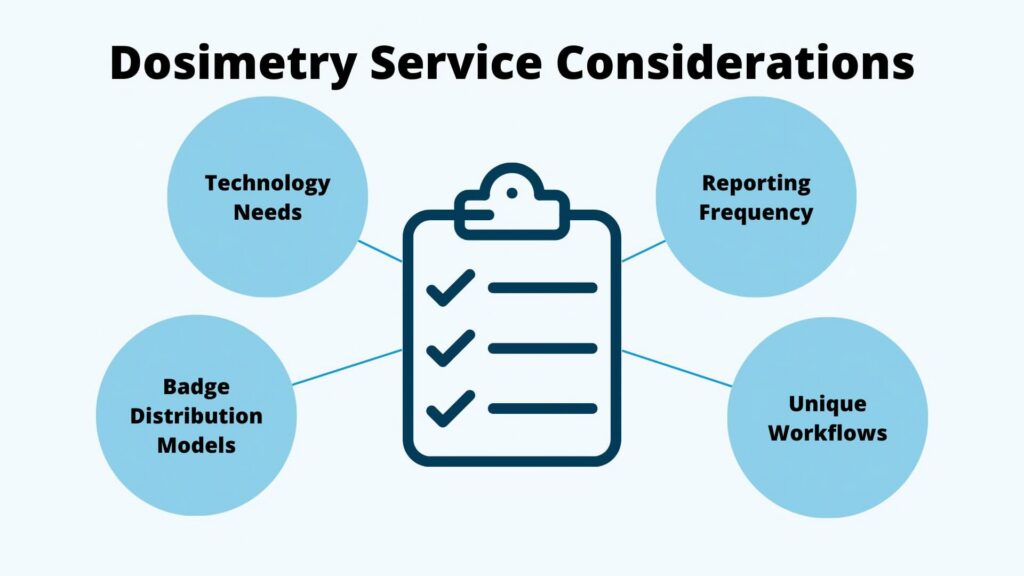
At Radiation Detection Company (RDC), we encourage organizations (especially hospitals, larger healthcare systems, or multi-site facilities) to begin with a direct consultation. Larger programs often have unique workflows, badge distribution models, reporting needs, and consolidation opportunities that a standard calculator cannot fully account for. A conversation allows us to align pricing with operational realities and identify opportunities for efficiency and customization.
For single-location or smaller teams seeking a fast estimate, our online pricing calculator provides transparent baseline per-badge rates based on reporting frequency, with volume discounts applied for every 10 badges. RDC provides dosimetry services on a subscription basis, with badges issued each wear period and processed upon timely return.
In short, direct consultations provide alignment and scalability for complex programs, while the pricing calculator delivers speed and clarity for straightforward monitoring needs.
To get transparent and custom pricing for your organization, contact Radiation Detection Company at 800.250.3314.
What Factors Influence Dosimetry Badge Pricing Most?
Size and scale aren’t the only considerations that impact your dosimetry budget. Dosimeter badge type and reporting frequency can also influence cost.
Dosimeter Badge Type: Technology Drives Cost Differences
One of the clearest pricing drivers in any dosimetry program is the type of radiation monitoring your staff actually needs.
Most providers price differently depending on whether the badge is used for traditional whole body exposure tracking, extremity monitoring in interventional environments, neutron-capable dosimetry in specialized settings, or newer digital dosimetry solutions.
Dosimeter Badge Technology Cost Comparison
| TLD or OSL | Digital | |
|---|---|---|
| Base Monitoring Cost | TLD & OSL typically comparable, Neutron typically higher | Typically higher than passive |
| Shipping Frequency Impact | Based on reporting period; monthly costs more than quarterly | Typically one-time for initial device shipment |
| Replacement Fees | May apply if late/lost/unreturned | Typically free for technical issues/battery; replacement fees apply if lost/damaged |
| Best Budget Fit | Stable, low-variability environments | High-risk/variable environments requiring multilocation oversight |
Traditional passive badges such as OSL and TLD remain the industry standard for many organizations because they are reliable, well-established, and cost-effective for routine occupational monitoring.
However, certain clinical and industrial environments require additional capabilities. Neutron monitoring, for example, involves specialized detector design and calibration requirements, which can affect overall program pricing.
Digital dosimetry is another important differentiator. While passive badges provide retrospective exposure data after processing, digital dosimeters can provide more immediate feedback, enhanced analytics, and workflow advantages for higher-risk or highly variable exposure environments. Because of the added technology and reporting infrastructure involved, digital monitoring programs are typically priced differently than standard passive services.
Some staff may require extremity monitoring or fetal monitoring in addition to whole body dosimeter badges. If you’re unsure which badge type aligns with your exposure environment, our team can help clarify baseline service options based on your program structure. Contact Radiation Detection Company at 800.250.3314 or submit an inquiry to get started.
Wear Period: Monthly vs. Quarterly Is One of the Biggest Pricing Levers
Wear frequency is another major factor that shapes dosimeter badge pricing.
Most organizations choose between monthly and quarterly reporting cycles, and the difference is not arbitrary. Monthly programs require more frequent shipment, processing, and dose reporting, which often increases annual program cost. In return, they provide more immediate exposure feedback and more responsive compliance oversight.
Quarterly monitoring reduces processing frequency and may be a practical option for lower-variability environments. However, it may not be ideal for hospital departments where staffing rotates frequently or where exposure levels can shift rapidly based on procedure mix.
Choosing Your Wear Period: Monthly vs. Quarterly
| Monthly Reporting – Best Fit If: | Quarterly Reporting – Best Fit If: |
|---|---|
| Exposures fluctuate/are difficult to predict | Exposures are stable and predictable |
| Procedure mix changes frequently | Procedure mix remains consistent |
| Staff rotate often | Staffing is steady with minimal changes |
| Faster dose visibility is important | Reviewing dose trends every 3 months is sufficient |
| You prefer tighter compliance oversight | You prioritize lower annual program cost |
| Monthly reporting increases cost but improves responsiveness and oversight. | Quarterly reporting reduces processing frequency and annual cost in stable environments. |
The key is that wear period decisions should reflect operational reality and radiation safety, not just cost. The right cycle improves compliance readiness and ensures dose trends are identified early rather than retroactively.
More Granularity with Digital Dosimetry
In some instances, more granular dose data is not just helpful, it’s essential. For declared pregnant workers, federal regulations limit exposure to 500 mrem over the entire gestation period, with a recommended guideline of no more than 50 mrem per month. More immediate visibility can provide pregnant employees with peace of mind while enabling program leaders to monitor trends proactively and intervene early if needed.
Likewise, traveling employees who fly often may see elevated readings due to airport screening equipment. In these cases, time-resolved readings through digital dosimetry make it possible to pinpoint when exposure occurred and cross-reference it with travel schedules, helping RSOs distinguish non-occupational exposure from true workplace dose.
Both applications justify the increased cost of digital dosimeters.
Why Is Dosimetry Pricing So Difficult to Compare?
One of the most common frustrations imaging leaders report is that pricing is rarely published in a way that supports true cost comparison.
Some dosimetry providers often require full sales engagement before disclosing detailed pricing, contract terms, or fee structures. That means imaging leaders may not fully understand total cost of ownership until after onboarding, when operational realities like lost badges, staffing fluctuations, or urgent reporting needs inevitably appear.
In practice, pricing transparency is less about the badge itself and more about what happens when the program encounters real-world friction.
For many organizations, this means you won’t know your real dosimetry cost until a badge is late, lost, or urgently needed.
At Radiation Detection Company, we believe pricing should be clear from the start. Many organizations come to us after discovering unexpected charges in their previous dosimetry program. Based on those experiences, we're sharing how to confirm what’s included in the base price for dosimetry service, and the most common areas where costs can escalate.
What’s Typically Included in the Base Dosimetry Price?
Despite pricing variation, most reputable dosimetry providers include core services within their standard monitoring rate.
In most cases, the base subscription covers badge usage, processing, standard dose reporting, online portal access, and customer support. Many providers also include control badges and routine program adjustments, such as staff additions or deletions.
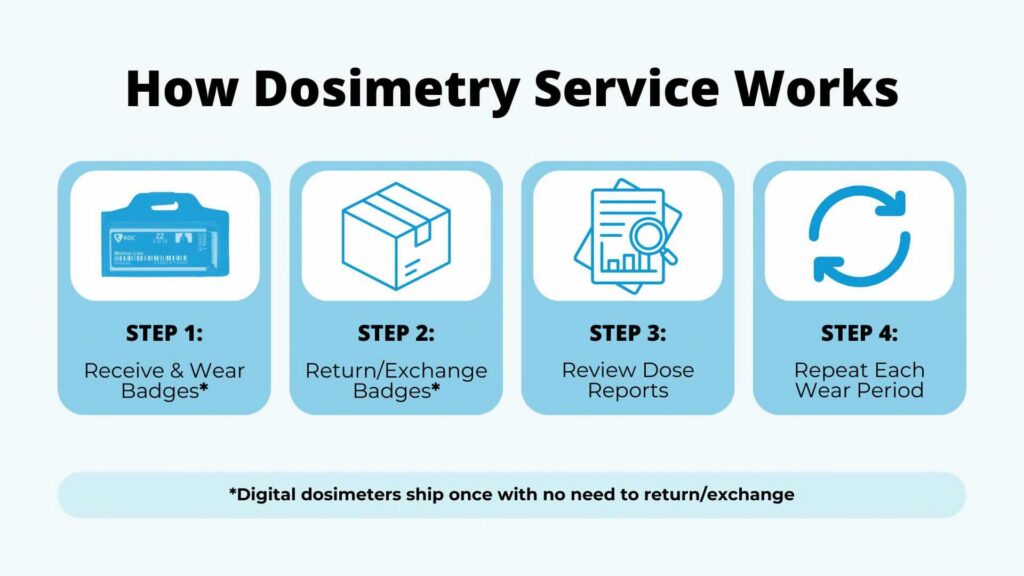
When comparing providers, confirm that baseline pricing includes badge processing and the reporting tools and service responsiveness needed to manage compliance effectively.
Base Program Cost at Radiation Detection Company
Here’s what’s included in your dosimetry contract with Radiation Detection Company:
- Seamless onboarding and account setup – simplified with SwitchAssist™
- Badges and outbound delivery with control badges in each shipment, and:
- Passive delivery scheduled based on your reporting period, or
- One-time delivery of NetDose™ digital dosimeters (battery lasts up to 3 years, and we proactively replace depleted devices)
- Dose reports
- Dose reports returned within 10 business days or fewer
- DDE, LDE, SDE for each badge/wearer with current reporting period, annual, and lifetime dose
- ALARA notifications for any affected employees
- 24/7 access to MyRadCare™, our customer dashboard
- Manage your account
- Add wearers
- View and print invoices
- View and print dose reports and Form 5s
- Employee 24/7 access to DoseCheck™
- Industry-leading customer service – 97% approval rating
Hidden Dosimetry Costs to Watch For
The biggest pricing differences between providers often come down to service policies rather than the baseline badge rate.
Because dosimeters remain provider property, most dosimetry providers require badges to be returned at the end of each wear period. When badges are not returned on time (or require replacement mid-cycle), additional charges may apply depending on provider policy.
Similarly, many dosimetry providers treat emergency processing, replacement shipments, or specialized reporting requests as add-on services rather than standard inclusions. These are often the areas where program cost diverges most over time, especially in busy clinical environments.
The best way to avoid surprises is to ask dosimetry providers directly what is included, what triggers additional costs, and how return timelines are handled.
Common Dosimetry Service Fees
- Return shipping (billed per shipment or prepaid program)
- Insufficient postage fees (for return shipments)
- Rush shipping – for emergency dosimeters or badges added mid-wear period
- Unreturned badge fees
- Access to enhanced analytics platforms
Comparing Dosimetry Providers Beyond Price
Dosimetry badge pricing is only one factor in selecting a provider. Dose accuracy, calibration integrity, reporting capabilities, customer support responsiveness, and technology differentiation are equally critical to long-term program success.
Providers with modern cloud-based customer platforms often stand out for audit readiness and multi-site oversight.
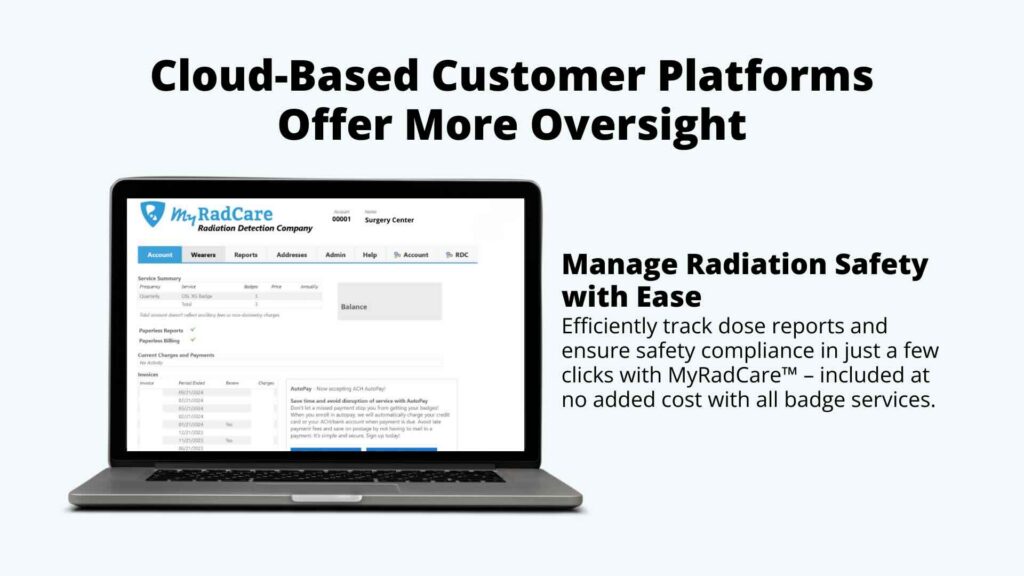
Cost and value are ultimately tied to reliability, not just the lowest per-badge quote. Service disruptions, unresponsive customer support, and late badge/report delivery can have costly consequences for organizations and create compliance risks.
Dosimetry Badge Pricing Is a Program Decision
Dosimetry badge pricing goes beyond base badge cost; reliable service keeps your employees safe and helps your organization stay compliant, efficient, and defensible over time.
Imaging leaders should evaluate pricing through the lens of wear period fit, badge technology, reporting needs, service responsiveness, and the provider's approach to transparency.
If your organization is larger, supports multiple locations, or has complex staffing workflows, our team is happy to provide tailored guidance and enterprise-level options designed to scale with your needs. Complete our contact form to connect with a dosimetry expert.
To see transparent baseline pricing for single-location organizations, explore Radiation Detection Company’s online pricing calculator.
Ready for transparent, customized pricing?
Call Radiation Detection Company at 800.250.3314 to speak with a dosimetry expert today.
Reach out to the Sales team now →
Calculate your badge cost now →
Frequently Asked Questions
What determines dosimetry badge pricing?
Pricing is primarily influenced by badge type, wear period frequency, subscription terms, and provider service policies.
Is monthly dosimetry more expensive than quarterly?
Typically yes, because monthly programs involve more frequent processing and faster dose feedback. The increased price stems from more frequent shipping.
Do neutron badges cost more than standard badges?
Most providers price neutron-capable monitoring differently due to specialized detector and calibration requirements.
How does digital dosimetry affect pricing?
Digital dosimeters often involve additional technology, reporting infrastructure, and real-time feedback capabilities, so they are typically priced differently than passive badge programs. For many organizations, the enhanced oversight justifies the increased cost.
Are dosimetry badges purchased or rented?
Most programs are subscription-based. Badges remain provider property and must be returned after each wear period.
What should I ask before starting dosimetry service?
Ask about included services, replacement policies, reporting access, additional fees, contract escalation terms, and renewal structure.





 Previous