Rereading an OSL dosimeter can confirm that a readout is consistent, but it cannot reveal upstream errors. True dosimetry accuracy depends on the controls applied before the first measurement ever occurs.
Across industries that rely on personal radiation monitoring, OSL dosimetry is seen as a stable, sensitive, and reliable method for measuring occupational dose. Materials like Al₂O₃:C and BeO have cemented OSL’s role in modern dosimetry programs. But even as these systems have matured, a widespread assumption continues to create false confidence: the belief that if a dosimeter is reread and produces the same number, the original result must be accurate.
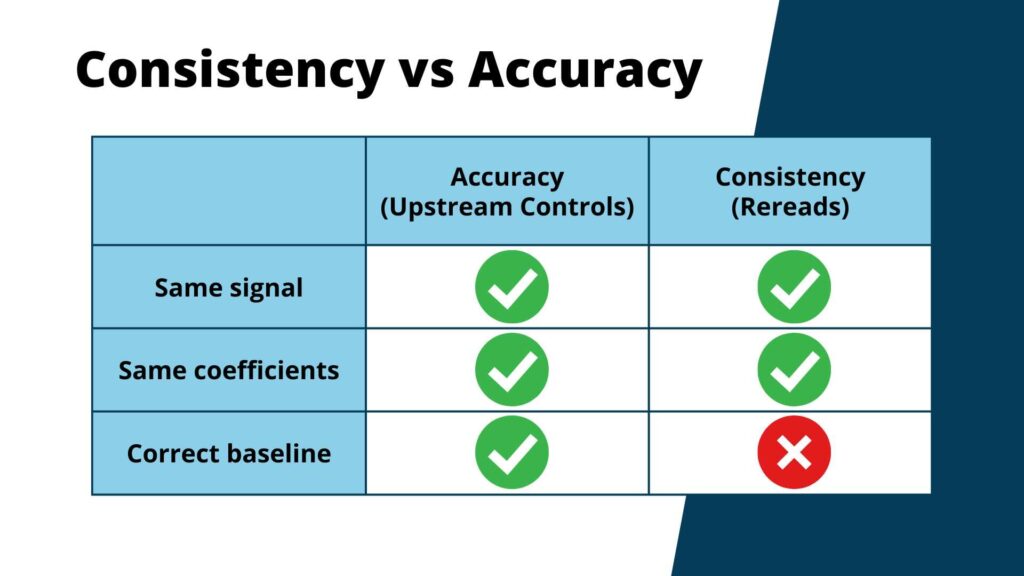
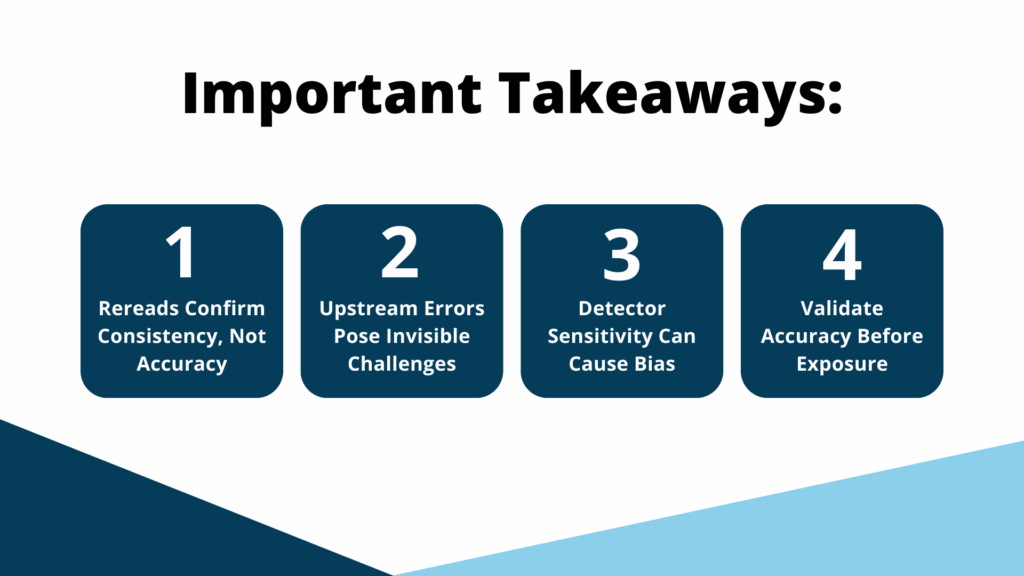
Unfortunately, rereading an OSL dosimeter does not function as a validation step – it is a repetition. Rereads confirm that the system is behaving consistently, but consistency is not the same thing as accuracy. Errors introduced upstream, before the first measurement, pose invisible challenges, regardless of how many times the dosimeter is read again.
For RSOs, physicists, and radiation safety professionals who rely on dose reports to make safety decisions, this distinction matters more than it may initially appear.
Key Takeaways
Rereads cannot detect upstream errors such as incomplete bleaching or incorrect sensitivity assignment.
Both OSL and TLD technologies suffer from residual signal issues when their reset (erasing or zeroing) processes are not fully effective.
Element-level variation in detector sensitivity can introduce persistent bias when batch-level correction factors are applied.
True dosimetry accuracy is the result of upstream quality controls, not downstream rereading.
High-accuracy programs treat dosimetry as a safety decision, not a production process.
How OSL Dosimetry Works (and Where Accuracy Can Break Down)
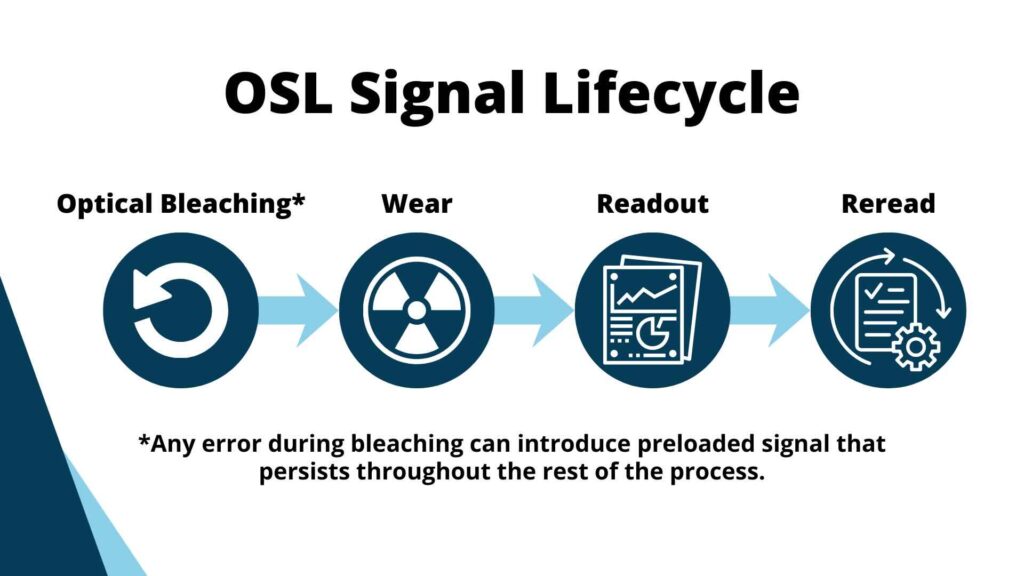
Optically stimulated dosimeters (OSLs) are effective because Al₂O₃:C and BeO store charged signal that can later be stimulated to produce a measurable luminescent light when the stored signal is released. Before each use, these materials must be fully optically bleached to remove any previously stored signal. In theory, this reset process establishes a clean baseline. In practice, complete bleaching is far more difficult to achieve consistently.
Even small variations in fixture geometry, light distribution, or dosimeter positioning can cause parts of the detector to receive insufficient bleaching energy. When that happens, the detector begins its next wear cycle with a preloaded signal, one that will be indistinguishable from true dose once exposure occurs. No reread will uncover this, because the reread simply interrogates the same flawed baseline.
OSLs are good detectors because of their high sensitivity and the ability to reread dosimeter badges for audits, investigations, or compliance-heavy environments using photon radiation. However, these benefits only ring true if the threat of residual signal is eliminated with complete annealing.
Thermoluminescent dosimeters (TLDs) face an analogous challenge through incomplete annealing. Although the physics differ, the consequence is identical: residual signal becomes embedded, undetectable, and influential.
Why Rereading Does Not Improve Dosimetry Accuracy
Rereading an OSL dosimeter often gives users a sense of reassurance – the idea that producing the same result twice confirms a correct measurement. But rereading only demonstrates that the reader is operating reproducibly; it does not tell you whether the detector began the process with the correct baseline, whether its sensitivity factor was accurate, or whether any upstream step introduced bias.
Once a detector is exposed, both the initial read and the reread reference the same trapped charge and apply the same sensitivity coefficients. If those coefficients are incorrect, or if the detector was never fully reset (erased or zeroed), the reread inherits the same error. In effect, the reread validates the process, not the truth.
"The industry often treats rereading as a safeguard. In reality, it is a diagnostic for reader performance, not a tool for validating dose."
– Chris Passmore, CHP
Regulatory bodies, including the US Nuclear Regulatory Commission, set clear expectations for accurate occupational dose reporting under 10 CFR 20.1201. These standards emphasize that compliance is built on accuracy, not on the ability to repeat a measurement.
The Sensitivity Challenge: Why Detector Variability Matters
Another significant contributor to uncertainty in OSL dosimetry is the natural variation that occurs between detector elements. Even within the same batch, Al₂O₃:C and BeO can vary considerably in light yield, trap density, and position-dependent behavior. Many multi-element dosimeters rely on a single batch correction factor, yet the underlying assumption (that all elements behave identically) is not supported by the physics or experience.
Variations in reader positioning, manufacturer tolerance on the detector carrier, stimulation focal point, and distribution of grain size can all contribute to the need for unique position-by-position or detector-by-detector sensitivity factors to reduce measurement uncertainty by adding accuracy and precision.
If a single element is more or less sensitive than the batch factor applied to it, the resulting dose will be biased every time that element is used – and because rereads reuse the same sensitivity coefficient, the bias persists. This source of error is subtle, pervasive, and invisible to downstream processing.
TLDs exhibit similar variability due to differences in trap structure and luminescence output. Both systems require careful element-level calibration to eliminate hidden sensitivity bias.
Detector-to-detector variability is well-documented in metrology literature, including the calibration work published by the National Institute of Standards and Technology (NIST), reinforcing the need for element-level sensitivity correction.
True Dosimetry Accuracy Is Defined Upstream, Not at the Reader
The question then becomes: How do high-accuracy dosimetry programs eliminate these uncertainties?
The answer lies in recognizing that accuracy is not achieved at the moment of readout. It is built through rigorous control of the steps that occur beforehand.
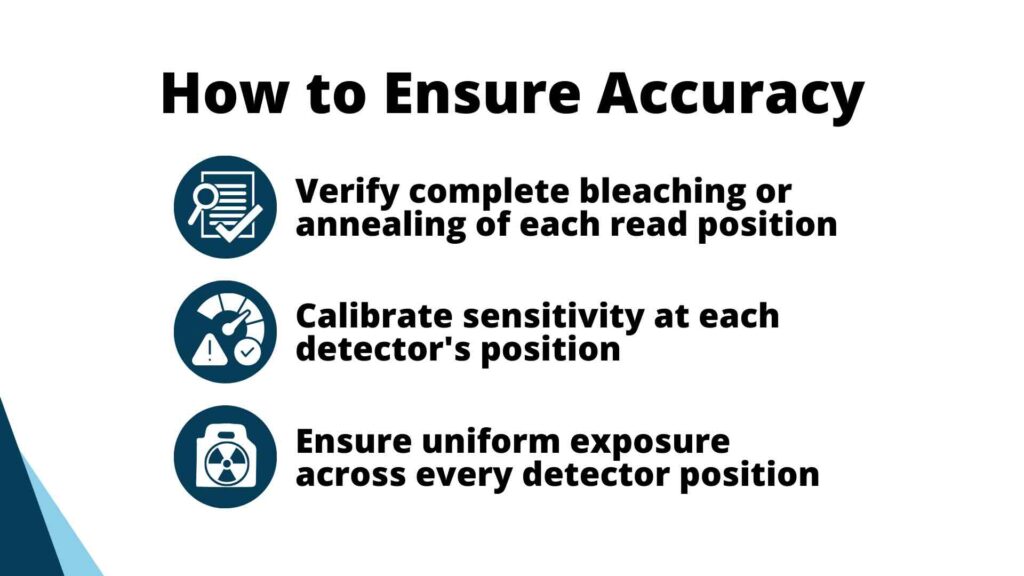
A program committed to dosimetry accuracy must:
Verify complete bleaching or annealing of each read position
Calibrate sensitivity at each detector's position
Ensure uniform optical or thermal exposure across every detector position through conformation, not assumption
These steps remove uncertainty before exposure occurs – the only time when uncertainty can still be removed at all.
Once a detector is worn and irradiated, any upstream error becomes permanent. No reread, regardless of how precise, can reverse an incorrect baseline.
For radiation safety professionals, this underscores a critical point: a dosimetry program is only as reliable as the controls applied before the first dose is ever recorded. Personnel monitoring programs are expected to meet the performance and documentation requirements outlined by the NRC and other regulatory agencies.
Commit to Upstream Accuracy
At Radiation Detection Company (RDC), we do not treat dosimetry as a throughput operation: we treat it as a matter of worker protection. That is why we take the additional time and effort to verify each detector and each element individually.
Full bleaching and thermal reset are confirmed, not assumed. Sensitivity calibration is performed at the element level rather than at the batch level. Every step is designed to eliminate uncertainty before the dosimeter ever reaches a worker.
Accuracy is not something we hope appears at the end of the process. It is something we engineer at the beginning.
At RDC, we deliver on our promises, with dosimeter and dose report accuracy you can rely on. Since 1949, we’ve provided trusted and reliable dosimetry service with #1-rated customer care for over 40,000 organizations.
Our approach is rooted in scientific accuracy and genuine care for our customers and communities we serve.
Why doesn’t rereading an OSL dosimeter validate the original dose?
Rereads use the same trapped charge and the same sensitivity factors as the initial measurement. If the detector started with an incorrect baseline or incorrect coefficient, the reread simply repeats the same error.
How does incomplete bleaching affect OSL dosimetry accuracy?
Incomplete bleaching embeds residual charge into the detector before exposure. Once the dosimeter is worn, this residual becomes indistinguishable from actual dose. Rereads cannot separate the two.
Do TLDs have the same accuracy limitations as OSL dosimeters?
Yes, although for different reasons. TLDs can retain residual signal when annealing is incomplete. Like OSLs, this residual signal cannot be detected after exposure.
How serious is detector-to-detector sensitivity variation?
Element-level variation can introduce meaningful bias. Programs that rely solely on batch-level correction factors leave this variation unaddressed and invisible.
What is the most important step for achieving high dosimetry accuracy?
Effective upstream control: full bleaching or annealing, uniform energy exposure, and element-level calibration. These are the only points in the workflow where accuracy can still be protected.
Ready to Simplify Your Radiation Safety Program?
Join 41,000+ organizations who trust Radiation Detection Company for accurate, timely, hassle-free radiation monitoring service.










 Previous