Learn the differences between alpha particles, beta particles, gamma rays, X-rays, and neutron radiation, including penetration, shielding, health risks, and radiation monitoring requirements.
The four common types of radiation include alpha particles, beta particles, photon radiation, and neutron radiation. These forms of radiation differ in their mass, energy, and how deeply they are able to penetrate objects and humans. In this article, we will more deeply explore radiation basics, as well as alpha, beta, photon, and neutron radiation.
Key Takeaways
Alpha particles are highly damaging inside the body but can be stopped by paper or skin
Beta particles travel farther than alpha particles and may penetrate skin
Photon radiation is highly penetrating, commonly used in medical imaging and radiation therapy, and requires shielding such as lead or concrete
Neutron radiation is difficult to shield and often requires hydrogen-rich materials
Different radiation types require different radiation monitoring and dosimetry solutions
The Basics of Radiation
Radiation is energy that travels either as particles or electromagnetic waves. It originates from unstable atoms undergoing radioactive decay or from machines such as X-ray equipment and particle accelerators.
There are two primary types of radiation: non-ionizing radiation and ionizing radiation.
Non-Ionizing Radiation
Non-ionizing radiation does not carry enough energy to remove electrons from atoms. Common examples include radio waves, visible light, and microwaves.
Humans are exposed to low levels of non-ionizing radiation every day. While intense exposure can cause tissue heating, this is uncommon outside specialized industrial or scientific environments.
Ionizing Radiation
Ionizing radiation carries enough energy to remove electrons from atoms in a process called ionization. This type of radiation can damage living tissue and DNA. Common sources include radioactive materials, cosmic radiation, gamma radiation, X-ray equipment, and radioactive decay.
Radioactive elements emit ionizing radiation as their atoms undergo radioactive decay, a process in which a radioactive atom spontaneously gives off radiation in the form of energy or particles in order to reach a more stable state. All types of nuclear radiation are ionizing radiation, while the reverse is not always true.
To put this in perspective: the worldwide average annual effective dose from natural background radiation is approximately 240 mrem (2.4 mSv) per year, excluding any occupational or medical exposure (UNSCEAR, 2024). In North America, the average is higher – around 300-310 mrem (3.0-3.1 mSv) per year.
For occupational radiation workers in the United States, the NRC annual occupational dose limits are:
Deep Dose Equivalent (DDE): 50 mSv (5 rem) per year
Lens Dose Equivalent (LDE): 150 mSv (15 rem) per year
Shallow Dose Equivalent (SDE): 500 mSv (50 rem) per year
Extremity Dose Equivalent (SDE): 500 mSv (50 rem) per year
These limits are established by the US Nuclear Regulatory Commission (10 CFR Part 20) for occupationally exposed workers.
Ionizing radiation can be categorized into four primary types: alpha particles, beta particles, photon radiation (gamma and X-rays), and neutron radiation. Each type behaves differently based on its mass, charge, energy, and ability to penetrate materials and human tissue.
Understanding these differences is essential for selecting proper shielding, monitoring occupational exposure, and maintaining an effective radiation safety program.
What Is an Alpha Particle?
Alpha particles (α) are positively charged particles made of two protons and two neutrons. They are emitted during alpha decay from heavy radioactive elements such as uranium, radium, thorium, and polonium.
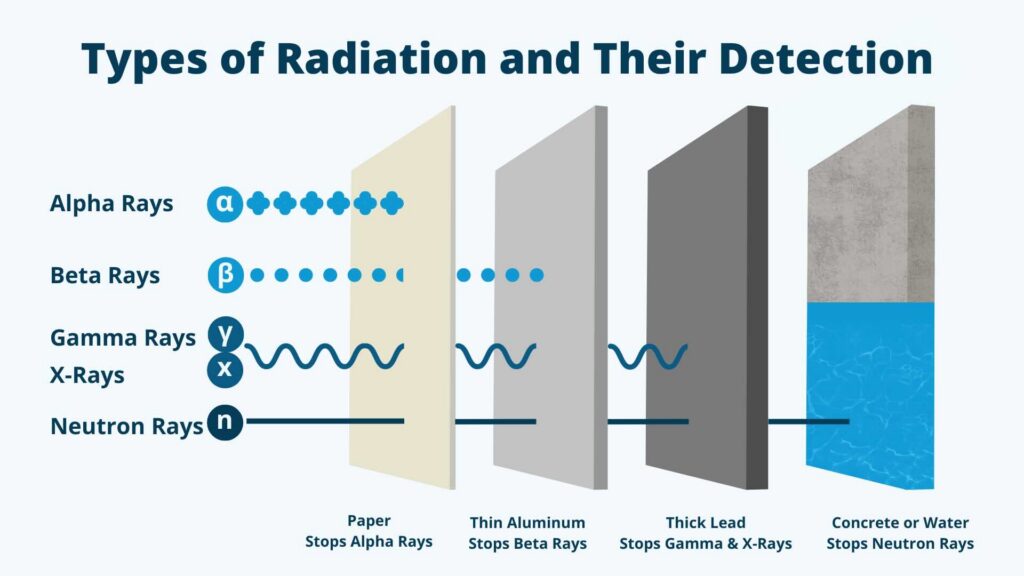
Although alpha particles are quite energetic, they are so heavy that they use up all of their energy over very short distances. This makes them incapable of traveling very far from the atom. In air, alpha particles typically travel only a few inches before losing all their energy – roughly the width of your hand.
The Dangers of Alpha Radiation
Alpha particles cannot penetrate skin, making external exposure relatively low risk. However, alpha emitters can be extremely dangerous if inhaled, ingested, injected, or absorbed through the skin or wounds because they can damage living tissue and cause severe cellular and DNA damage inside the body.
This makes these large, heavy particles more dangerous than other types of radiation, with alpha radiation resulting in more severe damage to cells and DNA.
What Is a Beta Particle?
Beta particles (β) are small, fast-moving electrons with a negative electrical charge. They are emitted during beta decay from unstable isotopes such as tritium, carbon-14, and strontium-90. Beta decay generally occurs in nuclei that have too many neutrons to achieve stability.
In air, beta particles can travel a bit further than alpha particles – up to a few feet – though the exact range depends on the energy of the emitting isotope.
The Dangers of Beta Radiation
Beta particles have a higher penetrating power than alpha particles, but they are less damaging to living tissue and DNA; they may penetrate skin, potentially causing burns or tissue damage. Thin materials such as clothing or aluminum can shield most beta radiation.
Like alpha emitters, beta emitters are most dangerous when inhaled or swallowed.
Gamma Rays and X-Rays: Understanding Photon Radiation
Gamma rays and X-rays are collectively known as photon radiation because both consist of high-energy electromagnetic waves. While they share many of the same properties, the primary difference is their origin: gamma rays originate in the atomic nucleus, while X-rays are produced outside the nucleus.
Gamma rays (γ) are high-energy electromagnetic waves emitted during radioactive decay and by some of the most energetic objects in the universe. They have the shortest wavelength and highest energy in the electromagnetic spectrum. While gamma rays and X-rays share similar properties, gamma rays originate from the atom’s nucleus, while X-rays come from processes outside the nucleus.
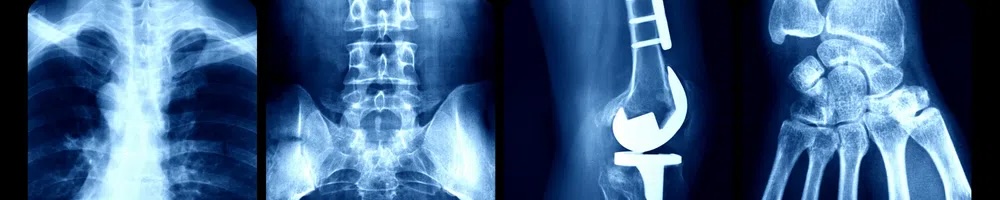
Photon beam radiation therapy is a form of cancer treatment that uses high-energy X-rays or gamma rays generated by a linear accelerator (LINAC). These radiation beams penetrate the body to target and destroy cancer cells while minimizing damage to surrounding tissue. Although photon beam therapy is sometimes confused with proton beam therapy, the two treatments use different types of radiation and delivery methods.
The Dangers of Photon Radiation
Photon radiation, including gamma rays and X-rays, poses a significant radiation hazard because it can penetrate deeply into the human body. Unlike alpha and beta radiation, photon radiation can pass through clothing, skin, and internal tissues, potentially damaging cells and DNA along its path. As a result, proper shielding and occupational dose monitoring are essential for workers who may be exposed.
The half-value layer (HVL) of lead is approximately 1 cm. The HVL is the thickness of shielding material required to reduce radiation intensity by 50%. Effective photon radiation shielding often requires several centimeters of lead or several feet of concrete, depending on the energy and intensity of the radiation source.
Neutron radiation is a type of ionizing radiation made up of free neutrons released during nuclear fission or nuclear fusion. Unlike alpha, beta, or photon radiation, neutrons carry no electrical charge, allowing them to penetrate deeply through many materials and human tissue.
When neutrons interact with atomic nuclei, they can create new isotopes in a process called neutron activation, which may make materials radioactive. Because neutron radiation can penetrate the entire body and cause significant biological damage, it is considered a serious occupational radiation hazard. Several feet of concrete, water, or other hydrogen-rich materials are often required for effective shielding.
The Dangers of Neutron Radiation
Neutron radiation is commonly produced by nuclear reactors, particle accelerators, industrial neutron sources, and cosmic ray interactions in the atmosphere.
Neutrons are especially dangerous because they have a high relative biological effectiveness (RBE), meaning they can cause greater cellular damage per unit of dose than gamma rays or X-rays. They are also difficult to shield, requiring hydrogen-rich materials such as water, polyethylene, paraffin wax, and concrete. Materials like boron and cadmium are commonly used to absorb neutrons.
Because standard gamma or X-ray dosimeters may not adequately measure neutron exposure, workers in neutron environments often require specialized neutron dosimetry. RDC’s TLD + Neutron dosimeter measures X-ray, beta, gamma, and neutron dose simultaneously to support accurate occupational radiation monitoring and compliance.
Comparing the Four Types of Radiation
Type
Alpha (α)
Beta (β)
Gamma (γ) & X-Rays
Neutron (n)
Penetrating Power
Very low: stopped by paper or skin
Moderate: stopped by thin aluminum
Very high: passes through the body
Very high: requires hydrogen-rich material
Shielding
Paper, dead skin
Aluminum, clothing
Lead (cm), concrete (feet)
Water, polyethylene, concrete
Common Sources
Uranium, radium, polonium decay
Tritium, carbon-14, strontium-90
Radioactive decay, medical LINACs
Fission, accelerators, cosmic rays
Detection
Geiger-Müller (GM) counters or scintillation detectors
Radiation exposure in occupational environments is monitored using personal dosimeters that measure cumulative dose over time. Depending on the radiation source and work environment, organizations may use TLD, OSL, or digital dosimeters to monitor worker exposure and maintain compliance with radiation safety regulations.
In order to meet occupational monitoring requirements outlined by the US Nuclear Regulatory Commission (NRC), not every dosimeter can serve as a legal dose of record. To satisfy regulatory requirements, dosimeters must be processed by a laboratory capable of providing accredited occupational dose reporting through the National Voluntary Laboratory Accreditation Program (NVLAP). Radiation Detection Company (RDC) is NVLAP-accredited (Lab Code 100512-0).
Selecting the appropriate dosimeter depends on the type of radiation present, expected exposure levels, and the monitoring requirements of the facility or organization.
Trusted Dosimetry Solutions by Radiation Detection Company
Radiation Detection Company (RDC) has helped organizations manage occupational radiation exposure for more than 75 years. Today, over 41,000 organizations trust RDC for reliable dosimetry programs tailored to healthcare, veterinary, dental, industrial, research, and other radiation safety environments.
Need help determining the best dosimetry options for the type of radiation your organization works with? RDC can help you select the right monitoring solution based on your radiation sources, work environment, and compliance needs.
The four common types of ionizing radiation are alpha particles, beta particles, photon radiation (gamma rays and X-rays), and neutron radiation.
Which type of radiation is the most penetrating?
Gamma rays, X-rays, and neutron radiation are the most penetrating forms of radiation and require dense or specialized shielding materials.
Can alpha particles penetrate skin?
No. Alpha particles are stopped by paper or the outer layer of skin, but they can be dangerous if inhaled or swallowed.
What materials block X-rays and gamma radiation?
Lead and concrete are commonly used to shield X-rays and gamma radiation because of their high density.
Why is neutron radiation difficult to shield?
Neutrons carry no electrical charge, allowing them to pass through many materials easily. Hydrogen-rich materials such as water and polyethylene are commonly used for neutron shielding.
What type of dosimeter is used for neutron radiation?
Workers exposed to neutron radiation often require specialized neutron dosimeters, such as RDC’s TLD + Neutron dosimeter, which measures X-ray, beta, gamma, and neutron exposure simultaneously.













 Previous